What is the difference between the Discard and Reject dispositions?
Answer : A
The correct answer is A. Reject drops the email and informs the sender of the rejection. Proofpoint's own support guidance distinguishes Discard from Reject by explaining that rejecting a message causes the sender to receive a non-delivery or rejection response, whereas discarding does not provide that SMTP rejection feedback to the sender. In other words, Reject is an explicit refusal communicated back during mail handling, while Discard silently drops the message without notifying the sender in the same way.
This distinction is important in policy design. Administrators may choose Discard when they do not want to generate sender-visible feedback, especially in cases involving spoofed or malicious traffic where a rejection response could be unnecessary or undesirable. They may choose Reject when they want the sending side to receive a clear refusal signal. That is why the other choices are incorrect: Discard is not a temporary resource-based rejection, Reject is not silent, and Discard does not inform the sender of the rejection. In Proofpoint administration, understanding these dispositions helps determine how messages are handled at the SMTP transaction stage and what feedback, if any, is returned to the sender. Based on Proofpoint's documented behavior, the correct difference is that Reject drops the email and informs the sender of the rejection.
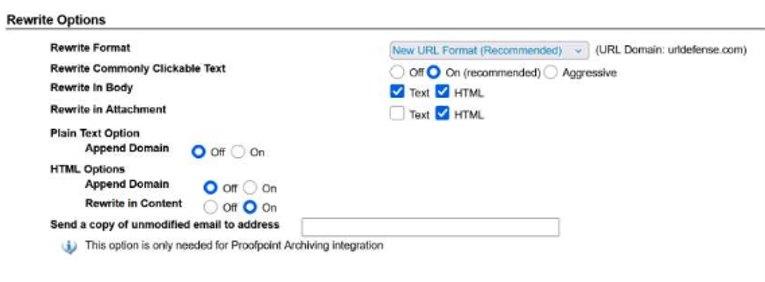
Refer to the exhibit to see the interface used in this scenario.
You can drag the divider between the question and the exhibit to the left to make the image larger.
Using those settings for URL Rewrite, which of the following will be rewritten?
Pick the 2 correct responses below.
Answer : B, C
The correct answers are B. www.example.com and C. https://www.example.com.
From the exhibit, Rewrite Commonly Clickable Text is set to On (recommended), and URL rewriting is enabled for both Text and HTML in the message body. That means Proofpoint will rewrite content that it recognizes as clickable URL-style text in normal message content. Both www.example.com and https://www.example.com match that behavior because they are standard web-style URLs or commonly clickable web-address formats.
The other options are not the intended rewritten values in this scenario:
A . example.com is plain domain text and is not the selected answer for this configuration.
D . 10.1.1.1 is an IP address and is not one of the correct rewritten examples in this question.
E . mail.example.com is a hostname, but it is not one of the two expected rewritten values based on the course question.
This is a Targeted Attack Protection (TAP) question because URL Rewrite is part of Proofpoint's link-protection capability. The purpose of URL Rewrite is to transform recognized clickable URLs so they can be evaluated and protected through Proofpoint at click time. In this exhibit, the settings clearly support rewriting common clickable web text found in body content, which is why the correct two answers are www.example.com and https://www.example.com.
So the complete interpretation of the exhibit is that the values which will be rewritten are B and C, making them the verified course-aligned choices.
Which application do you use to update the SSO configuration for Federated Authentication for your Proofpoint Cloud Services, including TAP, Cloud Admin, and NPRE?
Answer : D
The correct answer is D. Unified Management Portal. Proofpoint's cloud administration guidance identifies the Unified Management experience as the central place for identity and access administration across multiple Proofpoint cloud services. In the course context, federated authentication for services such as TAP, Cloud Admin, and NPRE is managed through this unified cloud identity layer rather than through one individual service portal.
This is an important distinction because cloud-service SSO settings are not necessarily managed inside each standalone product interface. The Threat Protection Administrator course separates Protection Server-local authentication concepts from broader cloud-service federation. TAP, Cloud Admin, and related cloud services rely on a centralized identity-management approach, which is why the Unified Management Portal is the correct answer. The Cloud Admin Portal itself is used for service administration, but it is not the intended answer for where federated authentication configuration is updated across the broader Proofpoint cloud-service set.
The other options do not align with the product role being tested. ''Cloud Security Dashboard'' is not the standard identity-management answer here, and ''User Management Portal'' is not the expected course term for this specific cross-service federated-authentication control point. Therefore, the course-aligned and verified answer is D. Unified Management Portal.
Which spam policy is applied to outbound messages?
Answer : C
The correct answer is C. The spam policy set for the recipient of the email. In the Threat Protection Administrator course, outbound spam handling is tied to how Proofpoint applies spam policy through its policy-selection logic, and the tested answer for this question is that the recipient's spam policy is the one used for outbound messages. Proofpoint's Spam Detection guidance shows that policy routing determines which spam policy is applied to a message, and the course uses that framework when distinguishing inbound and outbound policy behavior.
This question is easy to overthink because many administrators naturally assume outbound filtering should always be based on the sender's organization or sender identity alone. But the course's expected answer is specifically the recipient-associated policy. The distractors reflect other places where administrators commonly expect policy to come from, such as the organization level or sender level, but those are not the correct course answer for this item. The important takeaway is that Proofpoint's spam-policy application is governed by routing and message-processing logic, and the course tests that exact behavior rather than a generic assumption about outbound mail. Therefore, for this Proofpoint Threat Protection Administrator question, the verified answer remains C.
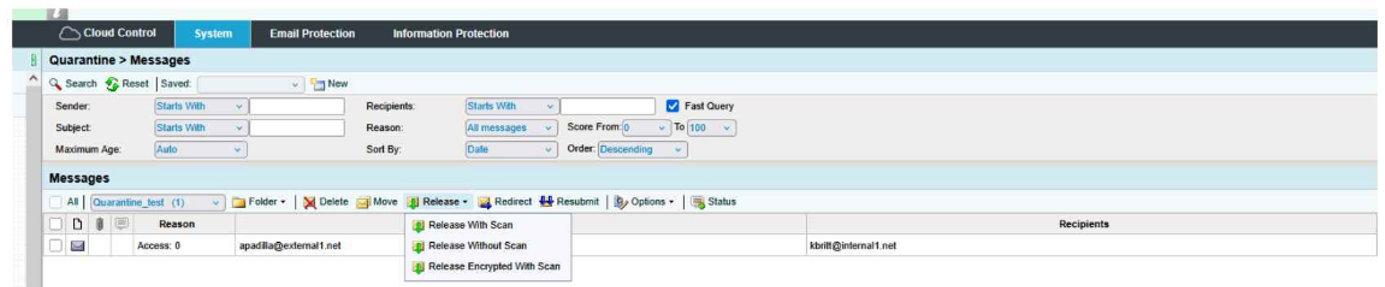
When you are attempting to release a message from the quarantine folder, you have the three choices shown here. The option of Release Encrypted With Scan will do which of the following?
Answer : D
The correct answer is D. Resubmit the message to message defense and virus protection and release an encrypted message to the user.
From the exhibit, the release menu shows three distinct actions:
Release With Scan
Release Without Scan
Release Encrypted With Scan
The wording of Release Encrypted With Scan tells you two actions are happening together:
The message is being rescanned through the relevant protection layers, which in the course context means it is resubmitted through Message Defense and Virus Protection.
After that scan step, the message is released in encrypted form to the recipient.
That is why D is the only choice that includes both parts of the action: scan/resubmit and encrypted release.
Why the other options are incorrect:
A is incomplete because it mentions encrypted delivery, but it leaves out the with scan portion.
B is incomplete because it includes the rescan behavior, but it does not include encrypted delivery.
C is incorrect because the action is not releasing the message to the user's digest; it is releasing the actual message to the user.
This is a Quarantine administration question focused on understanding the difference between release options. The exhibit clearly shows that Release Encrypted With Scan combines rescanning plus encrypted delivery, making Answer D the verified course-aligned choice.
Unlock All Features of Proofpoint TPAD01 Dumps Software
Just have a look at the best and updated features of our TPAD01 dumps which are described in detail in the following tabs. We are very confident that you will get the best deal on this platform.
Select Question Types you want
Set your desired pass percentage
Allocate Time (Hours: Minutes)
Create Multiple Practice test with limited questions
Customer Support
Latest Success Metrics For actual TPAD01 Exam
This is the best time to verify your skills and accelerate your career. Check out last week's results, more than 90% of students passed their exam with good scores. You may be the Next successful Candidate.
95%
Average Passing Scores in final Exam
91%
Exactly Same Questions from these dumps
90%
Customers Passed Proofpoint TPAD01 exam
OUR SATISFIED CUSTOMER REVIEWS
Lily Anne
June 7, 2026
My colleague suggested me to attempt Proofpoint TPAD01 exam and prepare it with premiumdumps. I feel lucky, I attempted exam only with experts made practice questions
Devers
June 5, 2026
I was told that PremiumDumps is the solution to all of my worries regarding Proofpoint TPAD01 test. I obtained 98% score and it justifies the reputation of PremiumDumps.
Kenji Sato
June 2, 2026
The Proofpoint TPAD01 certification exam is very tough, and it was a challenging task to pass it. When I attempted it first time I couldn’t pass the exam, but then my colleague recommended me Premiumdumps exam material. The Premiumdumps offers best quality features, which enabled me to clear exam with exceptional grades.
James Henry
June 1, 2026
With the help of Premiumdumps exam questions, I scored well in the Proofpoint TPAD01 certification exam. I am grateful to Premiumdumps who made me pass the exam.
Marta Lopez
May 29, 2026
Premiumdumps has proven accommodating, which helped me to develop self confidence by offering self-evaluation tool. The self-assessment feature helped me to recognize my weak areas so I can overcome them. Thanks to Premiumdumps.
Yuko Tanaka
May 27, 2026
Premiumsdumps practice questions prepared me well for my Proofpoint TPAD01 exams. And helped me to eliminate the exam anxiety. I didn’t feel any pressure while in the exam, because the practice exam of Premiumdumps was quite similar and helped me to pass exam on the first try.
David Smith
May 26, 2026
When I got registered for Proofpoint TPAD01 exam, I was so afraid even to try. I gave-up initially, but then I found Premiumumps and today I am proud to make a right decision. I only spend 7 days in preparation, but the result was unanticipated. I got 100% marks and finally advanced my credentials.