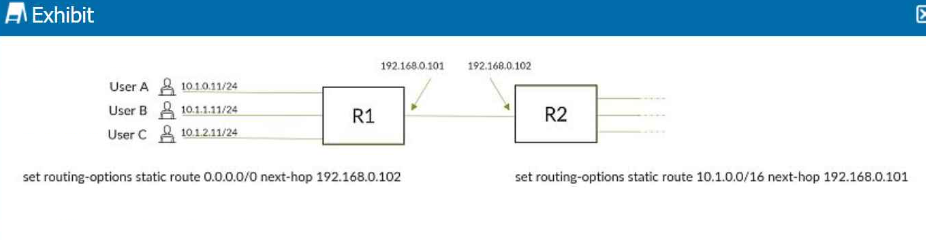
Which statement is correct about traffic flow in the network shown in the exhibit?
Answer : A
The configuration exhibit demonstrates a classic scenario where mismatched static routing leads to a routing loop. Router R1 is configured with a default route (0.0.0.0/0) pointing to R2 as its next hop. Conversely, R2 is configured with a broad static route for 10.1.0.0/16 pointing back to R1.
If a user sends a packet to an unassigned IP address such as 10.1.99.1, the following sequence occurs:
R1 receives the packet and consults its routing table. Finding no specific match for the 10.1.99.1 host, it uses the default route and forwards the packet to R2.
R2 receives the packet and identifies that 10.1.99.1 falls within its defined static route for 10.1.0.0/16.
Following its configuration, R2 forwards the packet back to R1. This process repeats indefinitely---or until the packet's Time to Live (TTL) reaches zero---because the broad summary on R2 encompasses addresses that R1 does not actually have a local path for. This illustrates the critical importance of ensuring that summary routes or default routes do not overlap in a way that creates circular forwarding paths for non-existent destinations. Reference: Routing Fundamentals, Static Route Configuration, Routing Loops and TTL.
Which protocol is used to discover the Layer 2 (MAC) address of a next hop for IPv6 hosts?
Answer : C
In the IPv6 protocol suite, the traditional Address Resolution Protocol (ARP) used in IPv4 has been deprecated and replaced by the Neighbor Discovery Protocol (NDP). NDP is a multifaceted protocol built upon the Internet Control Message Protocol version 6 (ICMPv6). Its primary purpose is to allow a host or router to determine the Layer 2 hardware (MAC) address of a neighbor on the same local link when only the neighbor's IPv6 address is known.
This specific process is known as Neighbor Solicitation and Neighbor Advertisement. When a Junos device needs to resolve a MAC address for an IPv6 next hop, it sends a Neighbor Solicitation (ICMPv6 Type 135) message to the solicited-node multicast address. The target host responds with a Neighbor Advertisement (ICMPv6 Type 136) containing its physical MAC address. Beyond address resolution, NDP also handles Router Discovery, Prefix Discovery, and Duplicate Address Detection (DAD). Unlike ARP, which relies on broadcasts that can impact all hosts on a segment, NDP utilizes efficient multicast communication. Understanding NDP is critical for Junos architects, as it is the foundational mechanism that facilitates logical-to-physical address mapping in modern IPv6 environments, ensuring that the Packet Forwarding Engine can properly encapsulate frames for local delivery.
What are two characteristics of IPv6 addressing? (Choose two.)
Answer : A, D
IPv6 introduces several fundamental shifts in networking architecture compared to its predecessor, IPv4. The most prominent characteristic is the address length; IPv6 utilizes a 128-bit address space, represented in hexadecimal notation across eight groups of 16 bits. This massive expansion from IPv4's 32-bit limit was designed to ensure long-term address availability for the global internet and the growing ecosystem of connected devices.
Another defining characteristic of IPv6 is the concept of address scope, particularly regarding link-local addresses. Any IPv6 address beginning with the fe80::/10 prefix is classified as link-local. These addresses are automatically configured on every IPv6-enabled interface and are strictly not routable beyond the local physical or logical link segment. They are essential for local link operations such as neighbor discovery and routing protocol adjacency formation.
Architecturally, IPv6 also improves performance by streamlining the packet header. Unlike IPv4, the IPv6 header does not include a checksum, as modern link-layer (Layer 2) and transport-layer (Layer 4) protocols perform their own error checking, making a redundant header checksum unnecessary at the network layer. Additionally, IPv6 replaces the broadcast-based Address Resolution Protocol (ARP) with the multicast-based Neighbor Discovery Protocol (NDP). Understanding these core traits---massive address length and non-routable link-local scoping---is critical for managing modern Junos-based network infrastructures.
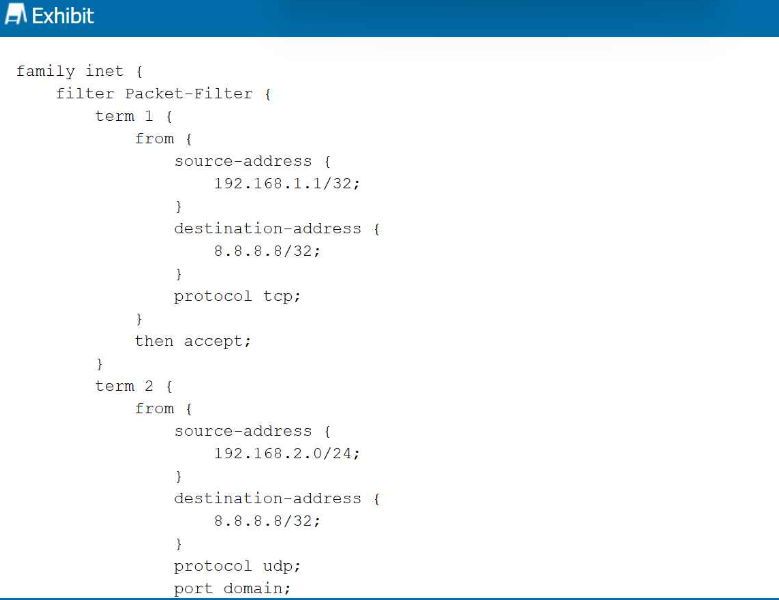
Referring to the exhibit, with firewall filter Packet-Filter attached to an interface, if traffic is sent from 192.168.1.1 to 8.8.8.8 for a UDP DNS query, what will happen to the traffic?
Answer : C
Junos OS firewall filters operate on a first-match basis, evaluating terms sequentially from top to bottom. In this scenario, a UDP DNS packet (destination port 53) is sent from 192.168.1.1 to 8.8.8.8. Evaluation begins with term 1, which matches the correct source and destination IP addresses but specifies protocol tcp. Because the actual traffic uses UDP, term 1 is not a match. Evaluation then moves to term 2. While term 2 correctly identifies protocol udp and port domain (port 53), it requires the source-address to reside within the 192.168.2.0/24 subnet. Since the source is 192.168.1.1, term 2 also fails to match.
When a packet fails to match any explicitly defined terms in a Junos firewall filter, it is subject to the implicit deny action. This default 'last term' is a hardcoded safety mechanism that automatically discards all traffic that has not been explicitly permitted. Consequently, because neither term provides a match for the specific combination of source IP, protocol, and destination port, the DNS query is silently dropped by the Packet Forwarding Engine. This behavior ensures that Junos devices maintain a 'deny-by-default' security posture, requiring administrators to define precise permit statements for all required transit or management traffic. Reference: Routing Policy and Firewall Filters, Firewall Filter Evaluation, Implicit Discard.
Which two traffic types are processed by a Routing Engine using Junos OS? (Choose two.)
Answer : C, D
The Routing Engine (RE) in a Junos device serves as the centralized intelligence and management hub, primarily responsible for the control and management planes of the system. In this capacity, the RE is tasked with processing routing updates, such as OSPF Link State Advertisements (LSAs) or BGP Update messages. These updates are vital for the RE to maintain the Routing Information Base (RIB), calculate the shortest paths, and subsequently populate the Forwarding Information Base (FIB) which is then pushed to the Packet Forwarding Engine (PFE).
Furthermore, the Routing Engine handles all local management traffic. This category encompasses administrative access through the Command Line Interface (CLI) via SSH or Telnet, SNMP queries from network management systems, and system logging processes. Because the RE runs the Junos OS kernel, it must directly interpret and respond to these management-level requests to ensure the device remains configurable and observable. Conversely, transit traffic---the data passing through the device from one ingress port to an egress port---is offloaded to the PFE to be handled at wire speed. While the PFE manages the heavy lifting of data forwarding and Class of Service (CoS) application, the RE remains focused on high-level protocol maintenance and system administration, ensuring that control plane stability is maintained even under heavy traffic loads. Reference: Junos OS Fundamentals, Control Plane Functions, Routing Engine Traffic.
Unlock All Features of Juniper JN0-106 Dumps Software
Just have a look at the best and updated features of our JN0-106 dumps which are described in detail in the following tabs. We are very confident that you will get the best deal on this platform.
Select Question Types you want
Set your desired pass percentage
Allocate Time (Hours: Minutes)
Create Multiple Practice test with limited questions
Customer Support
Latest Success Metrics For actual JN0-106 Exam
This is the best time to verify your skills and accelerate your career. Check out last week's results, more than 90% of students passed their exam with good scores. You may be the Next successful Candidate.
95%
Average Passing Scores in final Exam
91%
Exactly Same Questions from these dumps
90%
Customers Passed Juniper JN0-106 exam
OUR SATISFIED CUSTOMER REVIEWS
Noah James
July 3, 2026
I, being an average student, scored really well in JN0-106 Junos, Associate (OS 21.2) exam, only because of Premiumdumps practice questions. I highly recommend you to try actual exam dumps of Premiumdumps and pass the exam on the first try.
Devers
July 1, 2026
I was told that PremiumDumps is the solution to all of my worries regarding Juniper JN0-106 test. I obtained 98% score and it justifies the reputation of PremiumDumps.
Mia Elizabeth
June 30, 2026
I passed the Juniper JN0-106 exam with the help of Premiumdumps. I am glad to chose the right material to become successful in my career.
Jhonson
June 28, 2026
Premiumdumps is providing a very reliable support to all of the customers and so to me! I am very much obliged! I got 85% marks in my Certification test and this happened just because of Premiumdumps.
Jacinda Ardern
June 26, 2026
I have recently passed Juniper JN0-106 exam with the excellent results, on the first attempt. I owe thanks to Premiumdumps, who helped to become certified Professional.
João Silva
June 23, 2026
I would like to share, initially I was not sure if I could pass the Junos, Associate (OS 21.2) exam, because I didn’t get time to prepare for it. But Premiumdumps Practice exam helped me to fulfill my dream. The user friendly interface made be acquainted with the actual exam by offering the real exam simulation. I give all credits to Premiumdumps.
Emma Grace
June 21, 2026
Premiumdumps is a reliable and trustworthy platform, which enabled me to pass JN0-106. I am grateful that I only trusted Premiumdumps.