How is the Geofencing feature used in FortiSASE? (Choose one answer)
Answer : A
According to the FortiSASE 7.6 Administration Guide and the FCP - FortiSASE 24/25 Administrator study materials, the Geofencing feature is a security measure implemented at the edge of the FortiSASE cloud to control ingress connectivity based on the physical location of the user.
Access Control by Location (Option A): Geofencing allows administrators to allow or block remote user connections to the FortiSASE Points of Presence (PoPs) based on the source country, region, or specific network infrastructure (e.g., AWS, Azure, GCP).
Scope of Application: This feature is universal across all SASE connectivity methods. It applies to Agent-based users (FortiClient), Agentless users (SWG/PAC file), and Edge devices (FortiExtender/FortiAP). If a user attempts to connect from a blacklisted country, the connection is dropped at the PoP level before the user can even attempt to authenticate.
Use Case Example: An organization operating exclusively in North America might configure geofencing to block all connections originating from outside the US and Canada. This significantly reduces the attack surface by preventing brute-force or unauthorized access attempts from high-risk regions or countries where the organization has no legitimate employees.
Configuration Path: In the FortiSASE portal, this is managed under Configuration > Geofencing. From there, administrators can create an 'Allow' or 'Deny' list and select the relevant countries from a standardized global database.
Why other options are incorrect:
Option B: While FortiSASE supports Time-based schedules for firewall policies, geofencing is specifically an IP-to-Geography mapping tool for connection admission, not a time-of-day restriction tool.
Option C: Encryption of data at rest on mobile devices is a function of an MDM (Mobile Device Management) solution or local OS features (like FileVault or BitLocker), not a SASE network geofencing feature.
Option D: Monitoring web behavior and blocking non-work content is the role of the Web Filter and Application Control profiles, which operate on the traffic after the connection is allowed by geofencing.
Which three FortiSASE use cases are possible? (Choose three answers)
Answer : A, B, C
According to the FortiSASE 7.6 Architecture Guide and the FCP - FortiSASE 24/25 Administrator study materials, the FortiSASE solution is structured around three primary pillars or 'use cases' that address the security requirements of a modern distributed workforce.
Secure Internet Access (SIA) (Option A): This use case focus on protecting remote users as they browse the public internet. It utilizes a full cloud-delivered security stack including Web Filtering, DNS Filtering, Anti-Malware, and Intrusion Prevention (IPS) to ensure that users are protected from web-based threats regardless of their physical location.
Secure SaaS Access (SSA) (Option B): This use case addresses the security of cloud-based applications (like Microsoft 365, Salesforce, and Dropbox). It leverages Inline-CASB (Cloud Access Security Broker) to identify and control 'Shadow IT'---unauthorized cloud applications used by employees---and applies Data Loss Prevention (DLP) to prevent sensitive information from being leaked into unsanctioned SaaS platforms.
Secure Private Access (SPA) (Option C): This use case provides secure, granular access to private applications hosted in on-premises data centers or private clouds. It can be achieved through two main methods: ZTNA (Zero Trust Network Access), which provides session-specific access based on identity and device posture, or through SD-WAN integration, where the FortiSASE cloud acts as a spoke connecting to a corporate SD-WAN Hub.
Why other options are incorrect:
Secure VPN Access (SVA) (Option D): While SASE uses VPN technology (SSL or IPsec) as a transport for the Endpoint mode, 'SVA' is not a formal curriculum-defined use case. The SASE framework is intended to evolve beyond traditional 'Secure VPN Access' into the SIA and SPA models.
Secure Browser Access (SBA) (Option E): Although FortiSASE offers Remote Browser Isolation (RBI), it is considered a feature or a component of the broader Secure Internet Access (SIA) use case rather than a separate, standalone use case in the core administrator curriculum.
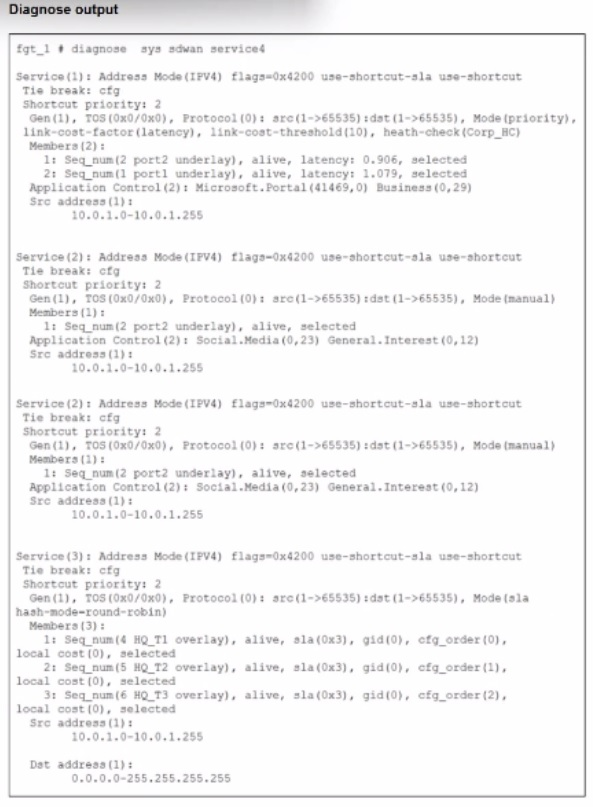
The exhibit shows output of the command diagnose sys sdwan service collected on a FortiGate device.
The administrator wants to know through which interface FortiGate will steer traffic from local users on subnet 10.0.1.0/255.255.255.192 and with a destination of the social media application Facebook.
Based on the exhibits, which two statements are correct? (Choose two.)
Answer : A, C
'If a flow is identified as belonging to a defined application category (such as social media), FortiGate will match it to the corresponding service rule (rule 2) and route it through the specified interface, such as port2. However, if the application is not recognized during the session setup, the system defaults to load balancing the traffic using the available tunnels according to the policy for unclassified traffic, ensuring continuous connectivity while waiting for application classification.'
This guarantees both performance and resilience.
What is the purpose of the on/off-net rule setting in FortiSASE?
Answer : C
According to the FortiSASE 24.4 Administration Guide and the FortiSASE Core Administrator training materials, the On-net detection rule setting is a critical component for determining the 'trust status' of an endpoint's physical location.
Endpoint Location Verification: On-net rule sets are used to determine if FortiSASE considers an endpoint to be on-net (trusted) or off-net (untrusted). An endpoint is considered on-net when it is physically located within the corporate network, which is assumed to already have on-premises security measures (like a FortiGate NGFW).
Operational Impact: When an endpoint is detected as on-net, FortiSASE can be configured to exempt the endpoint from automatically establishing a VPN tunnel to the SASE cloud. This optimization prevents redundant security inspection and conserves SASE bandwidth since the user is already protected by the local corporate firewall.
Detection Methods: To classify an endpoint as on-net, administrators configure rule sets that look for specific environmental markers, such as:
Known Public (WAN) IP: If the endpoint's public IP matches the corporate headquarters' egress IP.
DHCP Server: If the endpoint receives an IP from a specific corporate DHCP server.
DNS Server/Subnet: Matching internal DNS infrastructure or specific internal IP ranges.
Dynamic Policy Application: By accurately determining if an endpoint is on or off-net, FortiSASE ensures that the FortiClient agent only initiates its secure internet access (SIA) tunnel when the user is in an untrusted location (e.g., a home network or public Wi-Fi).
Why other options are incorrect:
Option A: User authentication is a separate process and is not controlled by the on/off-net detection rules, which focus on the network environment rather than user credentials.
Option B: While on-net status affects how traffic is routed (VPN vs. local), these rules specifically determine the status itself rather than defining the routing tables for private vs. cloud resources.
Option D: Geographical location (Geo-location) is a different filtering criterion often used in firewall policies; on-net detection is specifically about the proximity to the trusted corporate perimeter.
You have a FortiGate configuration with three user-defined SD-WAN zones and one or two members in each of these zones. One SD-WAN member is no longer used in health-check and SD-WAN rules. This member is the only member of its zone. You want to delete it.
What happens if you delete the SD-WAN member from the FortiGate GUI?
Answer : B
Questions no: 9 Verified Answer: B
Comprehensive and Detailed Explanation with all FortiSASE and SD-WAN 7.6 Core Administrator curriculum documents: According to the SD-WAN 7.6 Core Administrator study guide and FortiOS 7.6 Administration Guide, the behavior for deleting an SD-WAN member from the GUI when it is the only member in its zone is governed by the following operational logic:
Reference Checks: Before allowing the deletion of any SD-WAN member, FortiOS performs a 'check for dependencies.' If an interface is being used in an active Performance SLA or an SD-WAN Rule, the GUI will typically prevent the deletion or gray out the option until those references are removed. However, the question specifies that this member is no longer used in health-checks or rules.
Zone Integrity: Unlike some other network objects, an SD-WAN zone is permitted to exist without any members. When you delete the final member of a user-defined zone through the GUI, the zone itself remains in the configuration as an empty container.
Route Management: When an SD-WAN member is deleted, any static routes that were specifically tied to that interface's membership in the SD-WAN bundle are automatically updated or removed by the FortiGate to prevent routing loops or 'black-holing' traffic. This is part of the automated cleanup process handled by the FortiOS management plane.
GUI vs. CLI: In the GUI, the process is streamlined to allow the removal of the member interface. Once the member is deleted, the interface returns to being a 'regular' system interface and can be used for standard firewall policies or other functions.
Why other options are incorrect:
Option A: There is no requirement that a zone must contain at least one member; 'empty' zones are valid configuration objects in FortiOS 7.6.
Option C: While the deletion is accepted, it is not with 'no further action'---the system must still reconcile the routing table and interface status.
Option D: FortiGate does not automatically move deleted members into the default zone (virtual-wan-link). Once deleted, the interface is simply no longer an SD-WAN member.
Unlock All Features of Fortinet NSE5_SSE_AD-7.6 Dumps Software
Just have a look at the best and updated features of our NSE5_SSE_AD-7.6 dumps which are described in detail in the following tabs. We are very confident that you will get the best deal on this platform.
Select Question Types you want
Set your desired pass percentage
Allocate Time (Hours: Minutes)
Create Multiple Practice test with limited questions
Customer Support
Latest Success Metrics For actual NSE5_SSE_AD-7.6 Exam
This is the best time to verify your skills and accelerate your career. Check out last week's results, more than 90% of students passed their exam with good scores. You may be the Next successful Candidate.
95%
Average Passing Scores in final Exam
91%
Exactly Same Questions from these dumps
90%
Customers Passed Fortinet NSE5_SSE_AD-7.6 exam
OUR SATISFIED CUSTOMER REVIEWS
Jacinda Ardern
June 4, 2026
I have recently passed Fortinet NSE5_SSE_AD-7.6 exam with the excellent results, on the first attempt. I owe thanks to Premiumdumps, who helped to become certified Professional.
Emma Grace
June 1, 2026
Premiumdumps is a reliable and trustworthy platform, which enabled me to pass NSE5_SSE_AD-7.6. I am grateful that I only trusted Premiumdumps.
Lily Anne
May 31, 2026
My colleague suggested me to attempt Fortinet NSE5_SSE_AD-7.6 exam and prepare it with premiumdumps. I feel lucky, I attempted exam only with experts made practice questions
Yuko Tanaka
May 29, 2026
Premiumsdumps practice questions prepared me well for my Fortinet NSE5_SSE_AD-7.6 exams. And helped me to eliminate the exam anxiety. I didn’t feel any pressure while in the exam, because the practice exam of Premiumdumps was quite similar and helped me to pass exam on the first try.
Kenji Sato
May 27, 2026
The Fortinet NSE5_SSE_AD-7.6 certification exam is very tough, and it was a challenging task to pass it. When I attempted it first time I couldn’t pass the exam, but then my colleague recommended me Premiumdumps exam material. The Premiumdumps offers best quality features, which enabled me to clear exam with exceptional grades.
Leon Müller
May 25, 2026
I wish to share enthusiastically that I have finally advanced the credentials. And this has become possible just because of the Premiumdumps exam preparation material.
Jhonson
May 23, 2026
Premiumdumps is providing a very reliable support to all of the customers and so to me! I am very much obliged! I got 85% marks in my Certification test and this happened just because of Premiumdumps.