
Get XML I10-003 Exam Practice Questions - Real and Updated
XML Master Professional Database Administrator Exam Dumps
This Bundle Pack includes Following 3 Formats
Test software
Practice Test
Answers (PDF)

I10-003 Desktop Practice
Test Software
Total Questions : 39

I10-003 Questions & Answers
(PDF)
Total Questions : 39

I10-003 Web Based Self Assessment Practice Test


Following are some I10-003 Exam Questions for Review


See separate window.
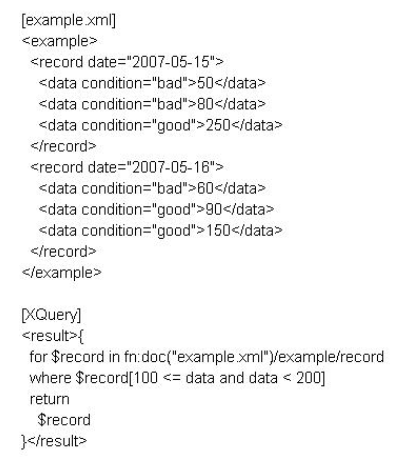
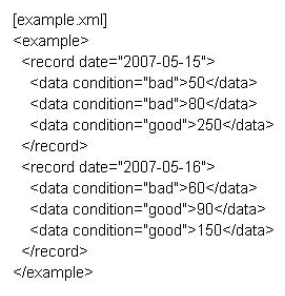
Assume you wish to execute a query on [example.xml] (separate window) to obtain a record element that includes a data element having a value equal to or greater than 100 and less than 200. Select the correct result of executing the [XQuery] (separate window). The expected result would be "C;" however, the query may not be processed as expected.
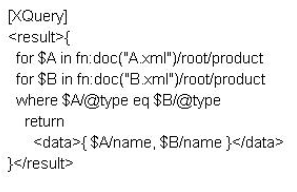
Consider the execution of [XQuery] as referenced in a separate window.
Assume that the following index is used when executing this [XQuery] on a certain XMLDB.
[Index Usage Standards] (assumed)
Use only the most efficient index when an index for both $A/@type and $B/@type is created.
If only one index is created, use that index.
Do not use an index if none is created.
Assume the following circumstances regarding the statistical values related to the execution of this [XQuery].
[Statistical Value] (assumed)
When creating an index for $A/@type, the response time when updating $A/@type data is one millisecond longeron average.
When creating an index for $B/@type. the response time when updating $B/@type data is one millisecond longeron average.
When creating an index for either $A/@type or$B/@type, or when creating an index for both, the response time of [XQuery] execution is at least two milliseconds shorter on average.
Of all of the values of $A/@type, the rate of inclusion of identical values is 1% on average. Of all of the values of $B/@type, the rate of inclusion of identical values is 2% on average. The ratio of $A/@type data update, $B/@type data update, and [XQuery] execution is 1:1:1 on average.
When the number of data items for both $A/@type and $B/@type are extremely large and almost identical, which is the most effective method for improving overall execution efficiency? Assume that this XMLDB has no other automated optimization functions than those described above. Assume that no other queries are executed.
A certain store engages in Internet commerce, managing customer information via XMLDB. Customers register as a user through a webpage, and are allowed to view their own information so they can edit their information themselves through a webpage interface. The store's Web application saves the customer information in an XMLDB, and retrieves data from the XMLDB as necessary. The XML data including customer information is as shown in [CUSTOMER.xml] referenced in a separate window.
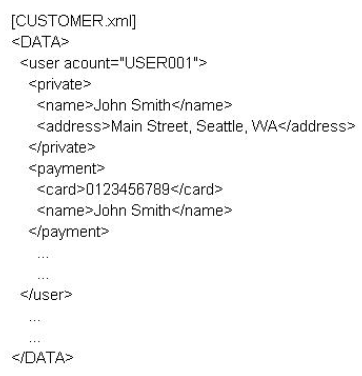
The XMLDB account when the Web application connects to the XMLDB is WEBAPP.
A person at the store is in charge of processing payments (access to all registered customer information), and this person's XMLDB account is COUNTER.
A person at the store is in charge of product shipments (access to all registered customer information except for payment information ("payment element")), and this person's XMLDB account is SHIPPER.
Do not consider XMLDB accounts other than those noted above.
Each account authorization in the XMLDB is presently configured as follows: The WEBAPP account has permission to update and view [CUSTOMER xml]
Other accounts have permission to view [CUSTOMER.xml]
Which is the most appropriate method in this situation regarding XMLDB account authorizations'?
Assume that this XMLDB has a view creation function (function to show only certain XML data in response to a certain query)
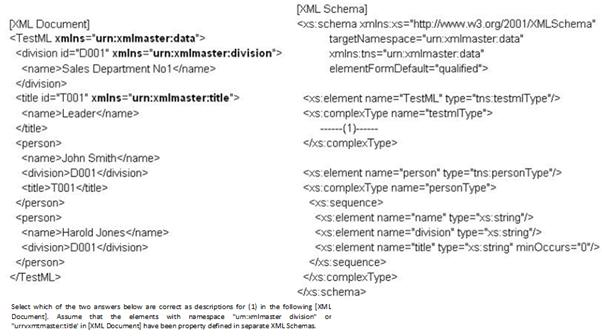
Assume that you wish to create an XML Schema document against which [XML Document] (referenced in a separate window) is valid.
Select the correct result of executing the following [XQuery] on [example xml] referenced in a separate window.
[XQuery]
for $record in fn:doc("example.xml")/example/record
return
}
Unlock All Features of XML I10-003 Dumps Software

Types you want

pass percentage

(Hours: Minutes)

Practice test with
limited questions

Support


