A is ambitious and cheerful at work. Which type of values are these?
Answer : D
Values represent basic convictions that a specific mode of conduct or end-state of existence is personally or socially preferable to an opposite mode. In Organizational Behavior, Milton Rokeach created the Rokeach Value Survey (RVS), which classifies values into two distinct sets: Terminal values and Instrumental values.
Terminal values refer to desirable end-states of existence. These are the goals a person would like to achieve during their lifetime, such as world peace, prosperity, or a sense of accomplishment. Instrumental values, on the other hand, refer to preferable modes of behavior or means of achieving the terminal values. Being 'ambitious' and 'cheerful' are behavioral traits or methods that an individual employs to reach their ultimate goals. For instance, being ambitious (an instrumental value) is the 'means' an employee uses to achieve the 'end' of financial success or career status (a terminal value). Similarly, being cheerful is a mode of conduct that might help an individual achieve the terminal goal of social recognition or happiness. Therefore, because these descriptions focus on the how of behavior rather than the what of ultimate life goals, they are strictly categorized as instrumental values. Understanding these values is crucial for managers because they influence motivation and how employees perceive organizational rewards and culture.
A team was assigned a project. Halfway through the project, however, it became obvious that the team was failing to meet expectations. Management had made sure that individuals assigned to the team had strong technical expertise as well as problem-solving and decision-making skills. However, other abilities for effective teamwork were overlooked. Which ability necessary for team members was overlooked?
Answer : C
To perform effectively, a team requires three different types of skills. First, it needs people with technical expertise to perform the task at hand. Second, it needs people with problem-solving and decision-making skills to be able to identify problems, generate alternatives, and make competent choices. Finally, and perhaps most importantly for group cohesion, a team needs people with strong interpersonal skills. Interpersonal skills include effective listening, feedback, and conflict resolution.
In the scenario provided, the team had the 'hard' skills (technical and analytical) but lacked the 'soft' skills required to navigate the social complexities of working as a unit. Without interpersonal skills, a team may have the smartest individuals but still fail because they cannot communicate effectively or resolve the inevitable friction that arises during a long-term project. While 'propensity for social loafing' is a behavior to avoid, and 'authoritarian personality' is often a hindrance, the foundational 'ability' cited in organizational behavior literature as a prerequisite for team success alongside technical and problem-solving skills is interpersonal competence.
Which dimension of the Fiedler contingency model is associated with the degree of influence a leader has over variables such as hiring, firing, discipline, promotions, and salary increases?
Answer : D
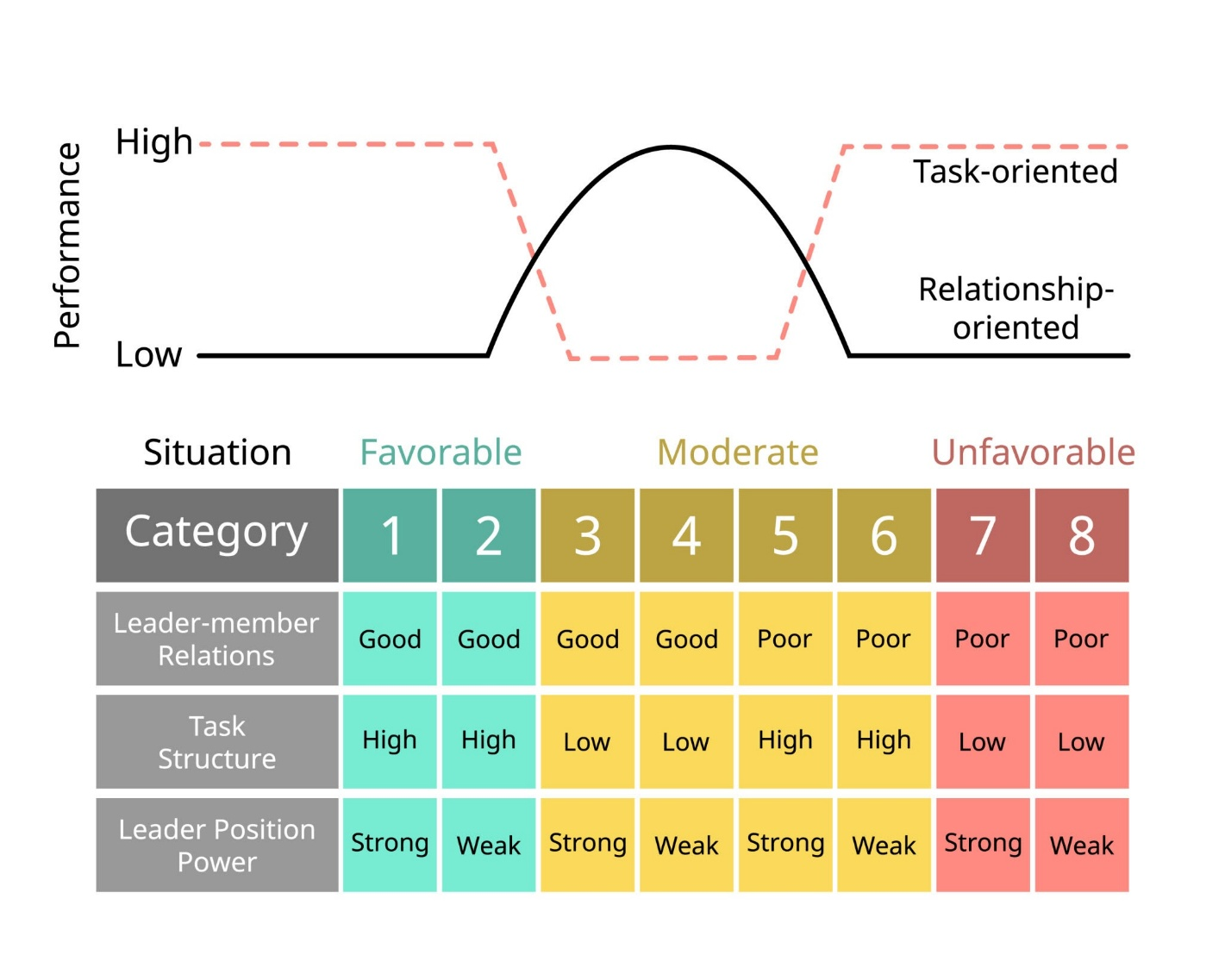
The Fiedler contingency model proposes that effective group performance depends on the proper match between the leader's style and the degree to which the situation gives control to the leader. Fiedler identified three contingency dimensions that define the situational favorableness: Leader-member relations, Task structure, and Position power.
Position power is specifically defined as the degree of influence a leader has over power variables such as hiring, firing, discipline, promotions, and salary increases. A leader with high position power has significant structural authority, which makes it easier to influence the behavior of subordinates through formal rewards and sanctions. In contrast, a leader with low position power must rely more heavily on personal influence or rapport to achieve goals. Understanding these dimensions is crucial because Fiedler argued that a leader's style is essentially fixed; therefore, to improve effectiveness, one must either change the leader to fit the situation or change the situation (such as increasing or decreasing the leader's position power) to fit the leader.
What is an aspect of cross-functional teams that makes them difficult to manage?
Answer : B
Cross-functional teams are composed of employees from about the same hierarchical level but from different work areas---such as marketing, finance, and production---who come together to accomplish a task. While these teams are highly effective for coordinating complex projects and solving problems that require diverse perspectives, they are notoriously difficult to manage in the early stages.
The primary challenge is that it takes time to build trust and teamwork among people with different backgrounds, experiences, and perspectives. Each member comes from a different functional 'culture' with its own jargon, priorities, and ways of looking at a problem. For example, a member from the engineering department might prioritize technical perfection, while a member from the marketing department might prioritize speed to market. These differing perspectives can lead to conflict and misunderstandings during the initial stages of group development. Furthermore, because members have primary loyalties to their home departments, creating a sense of 'team identity' takes significant effort from the leader. Leaders of cross-functional teams must spend considerable time facilitating communication, resolving interpersonal conflicts, and aligning the various functional goals into a single project vision. Until a baseline of mutual trust is established, the team may struggle with 'silo' thinking, where members protect their own department's interests rather than working toward the team's collective goal. Only after the team moves through the 'storming' phase of development and builds trust can it begin to leverage its diverse skills for high performance.
A manager treats an employee with a free lunch to encourage the employee to continue to do well. Which kind of reward is provided?
Answer : D
Motivation in the workplace is often driven by a system of rewards, which are generally categorized into intrinsic and extrinsic types. Intrinsic rewards are internal to the individual and come from the work itself; examples include a sense of accomplishment, personal growth, or the satisfaction of completing a difficult task. These are self-granted rewards.
Extrinsic rewards, conversely, are tangible rewards given by another person (usually a manager or the organization) to an employee for performing a specific task or behavior. These include salary increases, bonuses, promotions, benefits, and even smaller tokens like a free lunch. In this scenario, the free lunch is a physical, external incentive provided by the manager to reinforce the employee's positive performance. While intrinsic rewards are essential for long-term engagement and 'meaningful' work, extrinsic rewards like a free meal are effective for immediate reinforcement and recognizing specific achievements. According to reinforcement theory, providing such a reward immediately following a desired behavior (doing well at work) increases the probability that the behavior will be repeated. Because the lunch is an external, tangible benefit provided by the manager rather than an internal feeling of satisfaction derived from the task itself, it is classified as an extrinsic reward.
Unlock All Features of WGU Organizational Behavior Dumps Software
Just have a look at the best and updated features of our WGU Organizational Behavior dumps which are described in detail in the following tabs. We are very confident that you will get the best deal on this platform.
Select Question Types you want
Set your desired pass percentage
Allocate Time (Hours: Minutes)
Create Multiple Practice test with limited questions
Customer Support
Latest Success Metrics For actual WGU Organizational Behavior Exam
This is the best time to verify your skills and accelerate your career. Check out last week's results, more than 90% of students passed their exam with good scores. You may be the Next successful Candidate.
95%
Average Passing Scores in final Exam
91%
Exactly Same Questions from these dumps
90%
Customers Passed WGU Organizational Behavior exam
OUR SATISFIED CUSTOMER REVIEWS
David Smith
July 21, 2026
When I got registered for WGU Organizational Behavior exam, I was so afraid even to try. I gave-up initially, but then I found Premiumumps and today I am proud to make a right decision. I only spend 7 days in preparation, but the result was unanticipated. I got 100% marks and finally advanced my credentials.
Leon Müller
July 20, 2026
I wish to share enthusiastically that I have finally advanced the credentials. And this has become possible just because of the Premiumdumps exam preparation material.
Carlos Perez
July 18, 2026
Thank you Premiumdumps for offering the best and quality updated dumps questions and making me the certified Professional.
Ava Grace
July 16, 2026
When I got enrolled in WGU Organizational Behavior, I was told that Premiumdumps is the only key to all of my worries regarding my Exam. I scored well and it justifies the standard of Premiumdumps
Kenji Sato
July 13, 2026
The WGU Organizational Behavior certification exam is very tough, and it was a challenging task to pass it. When I attempted it first time I couldn’t pass the exam, but then my colleague recommended me Premiumdumps exam material. The Premiumdumps offers best quality features, which enabled me to clear exam with exceptional grades.
Emma Grace
July 11, 2026
Premiumdumps is a reliable and trustworthy platform, which enabled me to pass WGU Organizational Behavior. I am grateful that I only trusted Premiumdumps.
Devers
July 9, 2026
I was told that PremiumDumps is the solution to all of my worries regarding WGU Organizational Behavior test. I obtained 98% score and it justifies the reputation of PremiumDumps.