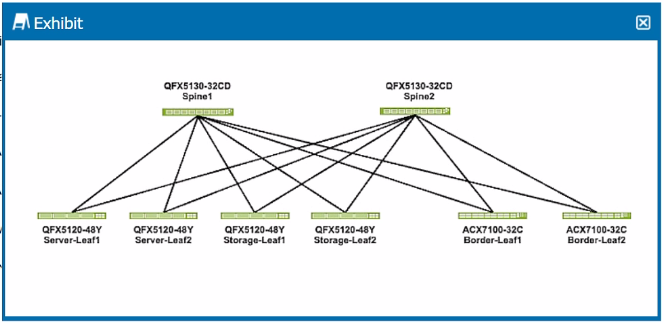
You are deploying an EVPN-VXLAN overlay. You must ensure that Layer 3 routing happens on the spine devices. In this scenario, which deployment architecture should you use?
Answer : B
Understanding EVPN-VXLAN Architectures:
EVPN-VXLAN overlays allow for scalable Layer 2 and Layer 3 services in modern data centers.
CRB (Centralized Routing and Bridging): In this architecture, the Layer 3 routing is centralized on spine devices, while the leaf devices focus on Layer 2 switching and VXLAN tunneling. This setup is optimal when the goal is to centralize routing for ease of management and to avoid complex routing at the leaf level.
ERB (Edge Routing and Bridging): This architecture places routing functions on the leaf devices, making it a distributed model where each leaf handles routing for its connected hosts.
Architecture Choice for Spine Routing:
Given the requirement to ensure Layer 3 routing happens on the spine devices, the CRB (Centralized Routing and Bridging) architecture is the correct choice. This configuration offloads routing tasks to the spine, centralizing control and potentially simplifying the overall design.
With CRB, the spine devices perform all routing between VXLAN segments. Leaf switches handle local switching and VXLAN encapsulation, but routing decisions are centralized at the spine level.
This model is particularly advantageous in scenarios where centralized management and routing control are desired, reducing the complexity and configuration burden on the leaf switches.
Data Center Reference:
The CRB architecture is commonly used in data centers where centralized control and simplified management are key design considerations. It allows the spines to act as the primary routing engines, ensuring that routing is handled in a consistent and scalable manner across the fabric.
Which two statements are correct when load balancing is enabled in this scenario? (Choose two.)
Answer : C, D
Load Balancing in VXLAN:
VXLAN uses UDP encapsulation to transport Layer 2 frames over an IP network. For load balancing across Equal-Cost Multi-Path (ECMP) links, various fields in the packet can be used to ensure even distribution of traffic.
Key Load Balancing Fields:
C . The source port in the UDP header is used to load balance VXLAN traffic: This is correct. The source UDP port in the VXLAN packet is typically calculated based on a hash of the inner packet's fields. This makes the source port vary between packets, enabling effective load balancing across multiple paths.
D . The inner packet fields are used in the hash for load balancing: This is also correct. Fields such as the source and destination IP addresses, source and destination MAC addresses, and possibly even higher-layer protocol information from the inner packet can be used to generate the hash that determines the ECMP path.
Incorrect Statements:
A . The inner packet fields are not used in the hash for load balancing: This is incorrect as the inner packet fields are indeed critical for generating the hash used in load balancing.
B . The destination port in the UDP header is used to load balance VXLAN traffic: This is incorrect because the destination UDP port in VXLAN packets is typically fixed (e.g., port 4789 for VXLAN), and therefore cannot be used for effective load balancing.
Data Center Reference:
Effective load balancing in VXLAN is crucial for ensuring high throughput and avoiding congestion on specific links. By using a combination of the source UDP port and inner packet fields, the network can distribute traffic evenly across available paths.
Connections between hosts connected to Leaf-1 and Leaf-2 are not working correctly.
Answer : C, E
Issue Analysis:
The problem in the exhibit suggests a mismatch in configuration parameters between Leaf-1 and Leaf-2, leading to communication issues between hosts connected to these leaf devices.
Configuration Mismatches:
Service-ID: Leaf-1 has service-id 1 configured, while Leaf-2 does not have this parameter. For consistency and proper operation, the service-id should be the same across both leaf devices.
VRF Target: Leaf-1 is configured with vrf-target target:65000:1, while Leaf-2 is configured with vrf-target target:65000:2. To allow proper VRF import/export between the two leafs, these should match.
Corrective Actions:
C . Configure the set switch-options vrf-target target:65000:1 parameter on Leaf-2: This aligns the VRF targets between the two leaf devices, ensuring they can correctly import and export routes.
E . Configure the set switch-options service-id 1 parameter on Leaf-2: This ensures that both Leaf-1 and Leaf-2 use the same service ID, which is necessary for consistency in the EVPN-VXLAN setup.
Data Center Reference:
Correct configuration of VRF targets and service IDs is critical in EVPN-VXLAN setups to ensure that routes and services are correctly shared and recognized between different devices in the network fabric.
A VXLAN tunnel has been created between leaf1 and Ieaf2 in your data center. Referring to the exhibit, which statement is correct?
Answer : C
Understanding VXLAN Tunneling:
VXLAN (Virtual Extensible LAN) is a network virtualization technology that addresses the scalability issues associated with traditional VLANs. VXLAN encapsulates Ethernet frames in UDP, allowing Layer 2 connectivity to extend across Layer 3 networks.
Each VXLAN network is identified by a unique VXLAN Network Identifier (VNI). In this exhibit, we have two VNIs, 5100 and 5200, assigned to the VXLAN tunnels between leaf1 and leaf2.
Network Setup Details:
Leaf1: Connected to Server1 with VLAN ID 100 and associated with VNI 5100.
Leaf2: Connected to Server2 with VLAN ID 200 and associated with VNI 5200.
Spine: Acts as the interconnect between leaf switches.
Traffic Flow Analysis:
When traffic is sent from Server1 to Server2, it is initially tagged with VLAN ID 100 on leaf1.
The traffic is encapsulated into a VXLAN packet with VNI 5100 on leaf1.
The packet is then sent across the network (via the spine) to leaf2.
On leaf2, the VXLAN header is removed, and the original Ethernet frame is decapsulated.
Leaf2 will then associate this traffic with VLAN ID 200 before forwarding it to Server2.
Correct Interpretation of the Exhibit:
The traffic originating from Server1, which is tagged with VLAN ID 100, will be encapsulated into VXLAN and transmitted to leaf2.
Upon arrival at leaf2, it will be decapsulated, and since it is associated with VNI 5200 on leaf2, the traffic will be retagged with VLAN ID 200.
Therefore, the traffic will reach Server2 tagged with VLAN ID 200, which matches the network configuration shown in the exhibit.
Data Center Reference:
This configuration is typical in data centers using VXLAN for network virtualization. It allows isolated Layer 2 segments (VLANs) to be stretched across Layer 3 boundaries while maintaining distinct VLAN IDs at each site.
This approach is efficient for scaling large data center networks while avoiding VLAN ID exhaustion and enabling easier segmentation.
In summary, the correct behavior, as per the exhibit and the detailed explanation, is that traffic sent from Server1 will be tagged with VLAN ID 200 when it reaches Server2 via leaf2. This ensures proper traffic segmentation and handling across the VXLAN-enabled data center network.
You are troubleshooting a DCI connection to another data center The BGP session to the provider is established, but the session to Border-Leaf-2 is not established. Referring to the exhibit, which configuration change should be made to solve the problem?
Answer : D, D
Understanding the Configuration:
The exhibit shows a BGP configuration on a Border-Leaf device. The BGP group UNDERLAY is used for the underlay network, OVERLAY for EVPN signaling, and PROVIDER for connecting to the provider network.
The OVERLAY group has the accept-remote-nexthop statement, which is designed to accept the next-hop address learned from the remote peer as is, without modifying it.
Problem Identification:
The BGP session to Border-Leaf-2 is not established. A common issue in EVPN-VXLAN environments is related to next-hop reachability, especially when accept-remote-nexthop is configured.
In typical EVPN-VXLAN setups, the next-hop address should be reachable within the overlay network. However, the accept-remote-nexthop can cause issues if the next-hop IP address is not directly reachable or conflicts with the expected behavior in the overlay.
Corrective Action:
Unlock All Features of Juniper JN0-683 Dumps Software
Just have a look at the best and updated features of our JN0-683 dumps which are described in detail in the following tabs. We are very confident that you will get the best deal on this platform.
Select Question Types you want
Set your desired pass percentage
Allocate Time (Hours: Minutes)
Create Multiple Practice test with limited questions
Customer Support
Latest Success Metrics For actual JN0-683 Exam
This is the best time to verify your skills and accelerate your career. Check out last week's results, more than 90% of students passed their exam with good scores. You may be the Next successful Candidate.
95%
Average Passing Scores in final Exam
91%
Exactly Same Questions from these dumps
90%
Customers Passed Juniper JN0-683 exam
OUR SATISFIED CUSTOMER REVIEWS
Grim
June 7, 2026
Premiumdumps Practice Questions have been a help for me whilst preparing for my Juniper JN0-683 test. I wanted to have 99% marks in the test and I did! Thanks to Premiumdumps!
João Silva
June 4, 2026
I would like to share, initially I was not sure if I could pass the Data Center Professional exam, because I didn’t get time to prepare for it. But Premiumdumps Practice exam helped me to fulfill my dream. The user friendly interface made be acquainted with the actual exam by offering the real exam simulation. I give all credits to Premiumdumps.
Devers
June 3, 2026
I was told that PremiumDumps is the solution to all of my worries regarding Juniper JN0-683 test. I obtained 98% score and it justifies the reputation of PremiumDumps.
James Henry
June 1, 2026
Premiumdumps made me self-confident and assured with success. Its real exam simulation and self assessment tools helped me to pass JN0-683 exam with good grades.
Jhonson
May 30, 2026
Premiumdumps is providing a very reliable support to all of the customers and so to me! I am very much obliged! I got 85% marks in my Certification test and this happened just because of Premiumdumps.
Jacinda Ardern
May 28, 2026
I have recently passed Juniper JN0-683 exam with the excellent results, on the first attempt. I owe thanks to Premiumdumps, who helped to become certified Professional.
Yuko Tanaka
May 25, 2026
Premiumsdumps practice questions prepared me well for my Juniper JN0-683 exams. And helped me to eliminate the exam anxiety. I didn’t feel any pressure while in the exam, because the practice exam of Premiumdumps was quite similar and helped me to pass exam on the first try.