You need to perform maintenance on one of your OSPF routers. You do not want the other OSPF routers on the network to forward traffic to this router dunng the maintenance window
Which OSPF configuration parameter would you implement to accomplish this task?
Answer : B
For maintenance scenarios where a router must remain operational but should not be used as a transit path for OSPF traffic, Junos OS uses the overload functionality.
OSPF Overload (Option B): When you enable overload under protocols ospf, the router advertises its own Link-State Advertisements (LSAs) with a maximum metric (65535) for all of its transit links.
Traffic Diversion: Because OSPF uses the Shortest Path First (SPF) algorithm to find the lowest-cost path, other routers in the network will see the overloaded router as an extremely high-cost path. They will calculate alternate routes, effectively moving transit traffic off the router while still allowing management traffic directed to the router's own interfaces.
Timeout Options: You can configure this to be permanent or set a timeout so that the router automatically resumes normal metric advertisements after a set period.
Which two statements are correct when using the no-loss forwarding class? (Choose two.)
Answer : B, C
In Junos OS 24.4, the no-loss forwarding class is used for traffic that requires lossless delivery, such as iSCSI or FCoE, typically in a Data Center Bridging (DCB) environment.
Priority-Based Flow Control (Option C): To guarantee 'no-loss' behavior, the switch must support and use Priority-based Flow Control (PFC). PFC allows the switch to send 'pause' frames for a specific priority (forwarding class) to prevent buffer overflow and packet drops without affecting other traffic on the same link.
Forwarding Class Sets (Option B): In enhanced Layer 2 software (ELS) versions used by modern QFX and EX series switches, lossless traffic must be managed within forwarding class sets (also known as priority groups). This grouping is necessary to apply specific DCB properties, such as PFC and specific bandwidth guarantees, to the lossless traffic class.
Why A and D are incorrect: Default scheduler maps and default drop profiles do not provide the specialized buffer management or lossless signaling required for this class. Lossless traffic specifically requires the suppression of tail drops rather than standard drop profiles.
When configuring Q-in-Q tunneling, which type of tunneling involves the swapping of S-VLANs with C-VLANs?
Answer : C
In a Juniper Q-in-Q (Layer 2 tunneling) environment, VLAN rewrites (specifically the swap operation) provide the most granular control over how customer traffic (C-VLANs) is mapped to service provider traffic (S-VLANs).
VLAN Rewrites (The Swap Operation): This method involves replacing the incoming customer VLAN tag with a service provider tag as the frame enters the tunnel. This is technically a 'swap' because the original C-VLAN tag is removed and the S-VLAN tag is written in its place. At the egress of the tunnel, the S-VLAN tag is swapped back for the original C-VLAN tag. This is often used when different customers use the same C-VLAN IDs and the provider needs to keep them unique within their core.
Many-to-Many: This is a mapping style where multiple customer VLANs are mapped to multiple service provider VLANs, but it typically relies on the 'push' (stacking) operation rather than a literal 'swap' of the tag itself.
All-in-One: This is the simplest form of Q-in-Q where all traffic entering an interface is 'pushed' into a single S-VLAN tag, regardless of any existing C-VLAN tags. No swapping occurs; the original tags are simply buried under the new provider tag.
L2PT (Layer 2 Protocol Tunneling): This is a feature used to tunnel Layer 2 control protocols (like STP, CDP, or LLDP) across a provider network by encapsulating them or changing their destination MAC addresses. It does not involve the swapping of VLAN tags.
Your router is discarding an EBGP route because the next hop is not directly connected. Which BGP configuration would you use to override this behavior?
Answer : B
In External BGP (EBGP), there is a default safety mechanism that requires the peer's next hop to be on a directly connected network.
TTL Constraint: By default, EBGP packets are sent with a Time-to-Live (TTL) value of 1. If the next hop is not directly connected (e.g., when peering via loopback interfaces or across a multi-hop path), the packet will expire before reaching the destination, causing the route to be discarded or the session to fail.
The Multihop Solution (Option B): To override this behavior, you must configure the multihop statement under the BGP neighbor or group hierarchy. This allows the BGP session to establish by increasing the TTL (typically to 64 or a user-defined value) and bypasses the 'directly connected' check.
Incorrect Options: Option A (accept-remote-nexthop) is used in internal BGP or specific routing-instance scenarios to resolve next hops that aren't in the local routing table, but it doesn't solve the EBGP TTL/direct-connection requirement. Option C (advertise-inactive) allows BGP to advertise routes that are not the best path in the routing table, which is irrelevant to next-hop reachability. Option D (multipath) is used for load-sharing across multiple paths.
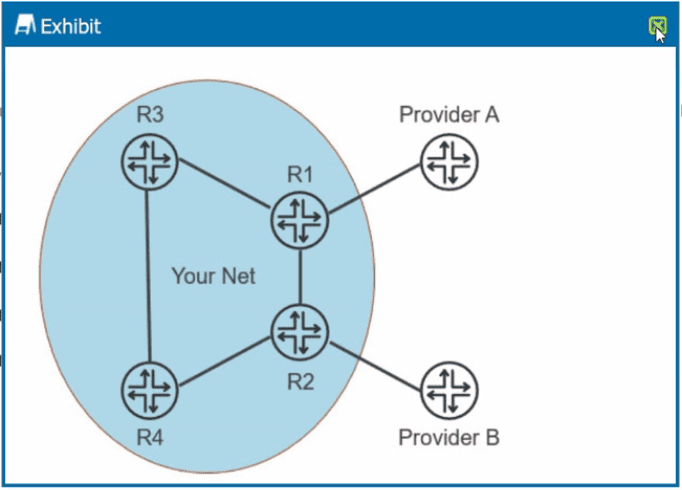
Your network receives the full Internet BGP routing table from two different ISPs. You want your local routers to use Provider A to forward all Internet traffic as long as Provider A is available.
Referring to the exhibit, which two actions would satisfy this requirement? (Choose two.)
Answer : A, C
In BGP path selection, the Local Preference attribute is one of the most common ways to influence outbound traffic from an Autonomous System (AS). It is a well-known discretionary attribute that is propagated throughout the AS to tell internal routers which path is preferred for a specific destination.
Priority Rule: In the BGP selection algorithm, a higher local preference value is always preferred over a lower one. The default value in Junos OS is 100.
Influencing Outbound Traffic (Option A): To ensure that Provider A is always preferred, you would apply an import policy on R1 (the router connected to Provider A) to set the local preference of all received routes to a value higher than the default (e.g., 200). Since 200 > 100, R3 and R4 will prefer the path via R1.
Alternative Method (Option C): Conversely, you can achieve the same result by applying an import policy on R2 (the router connected to Provider B) to set the local preference to a value lower than the default (e.g., 50). Since the routes from R1 remain at the default of 100, and 100 > 50, the path via R1 (Provider A) is preferred.
Why B and D are incorrect: Setting a higher local preference on R2 (Option B) would make Provider B the preferred exit point. Setting a lower local preference on R1 (Option D) would make Provider A the least preferred exit point.
Unlock All Features of Juniper JN0-650 Dumps Software
Just have a look at the best and updated features of our JN0-650 dumps which are described in detail in the following tabs. We are very confident that you will get the best deal on this platform.
Select Question Types you want
Set your desired pass percentage
Allocate Time (Hours: Minutes)
Create Multiple Practice test with limited questions
Customer Support
Latest Success Metrics For actual JN0-650 Exam
This is the best time to verify your skills and accelerate your career. Check out last week's results, more than 90% of students passed their exam with good scores. You may be the Next successful Candidate.
95%
Average Passing Scores in final Exam
91%
Exactly Same Questions from these dumps
90%
Customers Passed Juniper JN0-650 exam
OUR SATISFIED CUSTOMER REVIEWS
Lily Anne
June 15, 2026
My colleague suggested me to attempt Juniper JN0-650 exam and prepare it with premiumdumps. I feel lucky, I attempted exam only with experts made practice questions
David Smith
June 13, 2026
When I got registered for Juniper JN0-650 exam, I was so afraid even to try. I gave-up initially, but then I found Premiumumps and today I am proud to make a right decision. I only spend 7 days in preparation, but the result was unanticipated. I got 100% marks and finally advanced my credentials.
James Henry
June 11, 2026
Premiumdumps made me self-confident and assured with success. Its real exam simulation and self assessment tools helped me to pass JN0-650 exam with good grades.
Jhonson
June 10, 2026
Premiumdumps is providing a very reliable support to all of the customers and so to me! I am very much obliged! I got 85% marks in my Certification test and this happened just because of Premiumdumps.
Leon Müller
June 7, 2026
I wish to share enthusiastically that I have finally advanced the credentials. And this has become possible just because of the Premiumdumps exam preparation material.
Grim
June 6, 2026
Premiumdumps Practice Questions have been a help for me whilst preparing for my Juniper JN0-650 test. I wanted to have 99% marks in the test and I did! Thanks to Premiumdumps!
Carlos Perez
June 3, 2026
Thank you Premiumdumps for offering the best and quality updated dumps questions and making me the certified Professional.