Which encapsulation protocol uses tunneling to provide a Layer 2 overlay over an underlying Layer 3 network?
Answer : C
Encapsulation protocols are used to create overlay networks that provide connectivity over an underlying network. Let's analyze each option:
A . VLAN
Incorrect: VLANs operate at Layer 2 and are limited to a single physical network. They do not provide tunneling or overlay capabilities over a Layer 3 network.
B . IPsec
Incorrect: IPsec is a security protocol used to encrypt and authenticate IP packets. It does not provide Layer 2 overlay capabilities.
C . VXLAN
Correct: VXLAN (Virtual Extensible LAN) is an encapsulation protocol that creates a Layer 2 overlay network over an underlying Layer 3 network. It encapsulates Layer 2 Ethernet frames within UDP packets, enabling scalable and flexible network architectures.
D . GRE
Incorrect: GRE (Generic Routing Encapsulation) is a tunneling protocol that encapsulates packets but does not inherently provide Layer 2 overlay capabilities. It is typically used for point-to-point tunnels.
Why VXLAN?
Layer 2 Overlay: VXLAN extends Layer 2 networks across Layer 3 boundaries, enabling seamless communication between distributed environments.
Scalability: VXLAN supports up to 16 million virtual networks, making it ideal for large-scale cloud deployments.
JNCIA Cloud Reference:
The JNCIA-Cloud certification covers overlay networking protocols like VXLAN as part of its curriculum on cloud architectures. Understanding VXLAN is essential for designing scalable and resilient virtual networks.
For example, Juniper Contrail uses VXLAN to extend virtual networks across data centers, ensuring consistent connectivity and isolation.
VXLAN RFC 7348
Juniper JNCIA-Cloud Study Guide: Overlay Networking
You want to create a template that defines the CPU, RAM, and disk space properties that a VM will use when instantiated.
In this scenario, which OpenStack object should you create?
Answer : D
In OpenStack, a flavor defines the compute, memory, and storage properties of a virtual machine (VM) instance. Let's analyze each option:
A . role
Incorrect: A role defines permissions and access levels for users within a project. It is unrelated to defining VM properties.
B . Image
Incorrect: An image is a template used to create VM instances. While images define the operating system and initial configuration, they do not specify CPU, RAM, or disk space properties.
C . project
Incorrect: A project (or tenant) represents an isolated environment for managing resources. It does not define the properties of individual VMs.
D . flavor
Correct: A flavor specifies the CPU, RAM, and disk space properties that a VM will use when instantiated. For example, a flavor might define a VM with 2 vCPUs, 4 GB of RAM, and 20 GB of disk space.
Why Flavor?
Resource Specification: Flavors allow administrators to define standardized resource templates for VMs, ensuring consistency and simplifying resource allocation.
Flexibility: Users can select the appropriate flavor based on their workload requirements, making it easy to deploy VMs with predefined configurations.
JNCIA Cloud Reference:
The JNCIA-Cloud certification covers OpenStack concepts, including flavors, as part of its cloud infrastructure curriculum. Understanding how flavors define VM properties is essential for managing compute resources effectively.
For example, Juniper Contrail integrates with OpenStack Nova to provide advanced networking features for VMs deployed using specific flavors.
OpenStack Nova Documentation: Flavors
Juniper JNCIA-Cloud Study Guide: OpenStack Compute
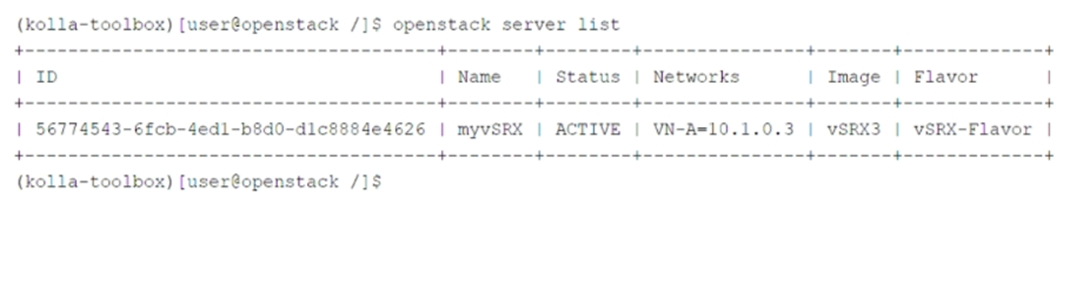
Referring to the exhibit, which two statements are correct? (Choose two.)
Answer : C, D
The openstack server list command provides information about virtual machine (VM) instances in the OpenStack environment. Let's analyze the exhibit and each statement:
Key Information from the Exhibit:
The output shows details about the myvSRX instance:
Status: ACTIVE (indicating the instance is running).
Networks: VN-A-10.1.0.3 (indicating the instance is part of a specific network).
Image: vSRX3 (indicating the instance was created using a custom image).
Flavor: vSRX-Flavor (indicating the instance was created using a custom flavor).
Option Analysis:
A . The myvSRX instance is using a default image.
Incorrect: The image name vSRX3 suggests that this is a custom image, not the default image provided by OpenStack.
B . The myvSRX instance is a part of a default network.
Incorrect: The network name VN-A-10.1.0.3 indicates that the instance is part of a specific network, not the default network.
C . The myvSRX instance is created using a custom flavor.
Correct: The flavor name vSRX-Flavor indicates that the instance was created using a custom flavor, which defines the CPU, RAM, and disk space properties.
D . The myvSRX instance is currently running.
Correct: The ACTIVE status confirms that the instance is currently running.
Why These Statements?
Custom Flavor: The vSRX-Flavor name clearly indicates that a custom flavor was used to define the instance's resource allocation.
Running Instance: The ACTIVE status confirms that the instance is operational and available for use.
JNCIA Cloud Reference:
The JNCIA-Cloud certification emphasizes understanding OpenStack commands and outputs, including the openstack server list command. Recognizing how images, flavors, and statuses are represented is essential for managing VM instances effectively.
For example, Juniper Contrail integrates with OpenStack Nova to provide advanced networking features for VMs, ensuring seamless operation based on their configurations.
OpenStack CLI Documentation: openstack server list Command
Juniper JNCIA-Cloud Study Guide: OpenStack Compute
Which OpenShift resource represents a Kubernetes namespace?
Answer : A
OpenShift is a Kubernetes-based container platform that introduces additional abstractions and terminologies. Let's analyze each option:
A . Project
Correct:
In OpenShift, a Project represents a Kubernetes namespace with additional capabilities. It provides a logical grouping of resources and enables multi-tenancy by isolating resources between projects.
B . ResourceQuota
Incorrect:
A ResourceQuota is a Kubernetes object that limits the amount of resources (e.g., CPU, memory) that can be consumed within a namespace. While it is used within a project, it is not the same as a namespace.
C . Build
Incorrect:
A Build is an OpenShift-specific resource used to transform source code into container images. It is unrelated to namespaces or projects.
D . Operator
Incorrect:
An Operator is a Kubernetes extension that automates the management of complex applications. It operates within a namespace but does not represent a namespace itself.
Why Project?
Namespace Abstraction: OpenShift Projects extend Kubernetes namespaces by adding features like user roles, quotas, and lifecycle management.
Multi-Tenancy: Projects enable organizations to isolate workloads and resources for different teams or applications.
JNCIA Cloud Reference:
The JNCIA-Cloud certification covers OpenShift and its integration with Kubernetes. Understanding the relationship between Projects and namespaces is essential for managing OpenShift environments.
For example, Juniper Contrail integrates with OpenShift to provide advanced networking and security features for Projects, ensuring secure and efficient resource isolation.
OpenShift Documentation: Projects
Juniper JNCIA-Cloud Study Guide: OpenShift and Kubernetes
Which component of Kubernetes runs on each node maintaining network rules?
Answer : B
Kubernetes components work together to ensure seamless communication and network functionality within the cluster. Let's analyze each option:
A . container runtime
Incorrect: The container runtime (e.g., containerd, cri-o) is responsible for running containers on worker nodes. It does not maintain network rules.
B . kube-proxy
Correct: kube-proxy is a Kubernetes component that runs on each node and maintains network rules to enable communication between services and pods. It ensures proper load balancing and routing of traffic.
C . kubelet
Incorrect: The kubelet is responsible for managing the state of pods and containers on a node. It does not handle network rules.
D . kube controller
Incorrect: The kube controller manages the desired state of the cluster, such as maintaining the correct number of replicas. It does not directly manage network rules.
Why kube-proxy?
Network Rules: kube-proxy implements iptables or IPVS rules to route traffic between services and pods, ensuring seamless communication.
Load Balancing: It provides basic load balancing for services, distributing traffic across available pods.
JNCIA Cloud Reference:
The JNCIA-Cloud certification covers Kubernetes networking, including the role of kube-proxy. Understanding how kube-proxy works is essential for managing network communication in Kubernetes clusters.
For example, Juniper Contrail integrates with Kubernetes to enhance networking capabilities, leveraging kube-proxy for service-level traffic management.
Kubernetes Documentation: kube-proxy
Juniper JNCIA-Cloud Study Guide: Kubernetes Networking
Unlock All Features of Juniper JN0-214 Dumps Software
Just have a look at the best and updated features of our JN0-214 dumps which are described in detail in the following tabs. We are very confident that you will get the best deal on this platform.
Select Question Types you want
Set your desired pass percentage
Allocate Time (Hours: Minutes)
Create Multiple Practice test with limited questions
Customer Support
Latest Success Metrics For actual JN0-214 Exam
This is the best time to verify your skills and accelerate your career. Check out last week's results, more than 90% of students passed their exam with good scores. You may be the Next successful Candidate.
95%
Average Passing Scores in final Exam
91%
Exactly Same Questions from these dumps
90%
Customers Passed Juniper JN0-214 exam
OUR SATISFIED CUSTOMER REVIEWS
Mia Elizabeth
June 15, 2026
I passed the Juniper JN0-214 exam with the help of Premiumdumps. I am glad to chose the right material to become successful in my career.
Grim
June 13, 2026
Premiumdumps Practice Questions have been a help for me whilst preparing for my Juniper JN0-214 test. I wanted to have 99% marks in the test and I did! Thanks to Premiumdumps!
Lily Anne
June 12, 2026
My colleague suggested me to attempt Juniper JN0-214 exam and prepare it with premiumdumps. I feel lucky, I attempted exam only with experts made practice questions
Jhonson
June 10, 2026
Premiumdumps is providing a very reliable support to all of the customers and so to me! I am very much obliged! I got 85% marks in my Certification test and this happened just because of Premiumdumps.
Leon Müller
June 7, 2026
I wish to share enthusiastically that I have finally advanced the credentials. And this has become possible just because of the Premiumdumps exam preparation material.
Yuko Tanaka
June 6, 2026
Premiumsdumps practice questions prepared me well for my Juniper JN0-214 exams. And helped me to eliminate the exam anxiety. I didn’t feel any pressure while in the exam, because the practice exam of Premiumdumps was quite similar and helped me to pass exam on the first try.
Emma Grace
June 3, 2026
Premiumdumps is a reliable and trustworthy platform, which enabled me to pass JN0-214. I am grateful that I only trusted Premiumdumps.