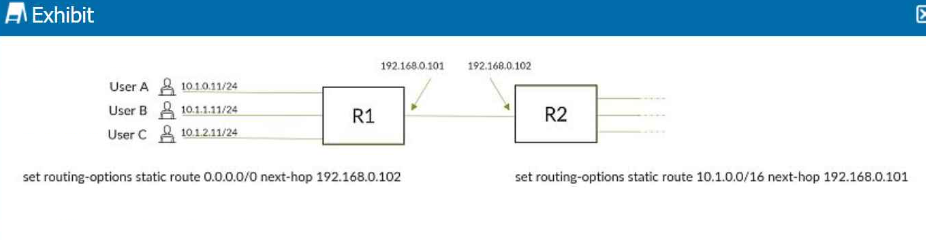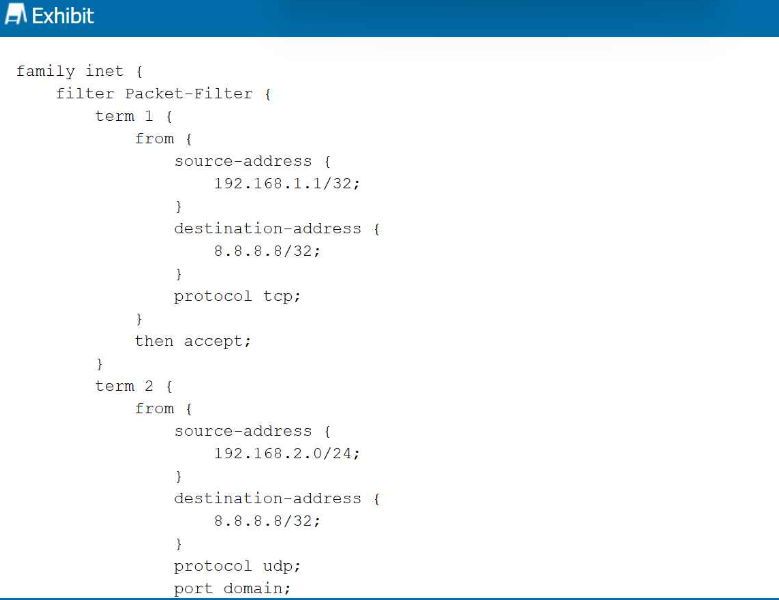
Referring to the exhibit, which two statements about IPv6 routing are correct? (Choose two.)
Answer : A, B
The provided exhibit displays the output of the show route table inet6.0 command, which represents the master routing table for IPv6 unicast traffic in Junos OS. Analysis of the specific route entries reveals that all listed destinations are categorized as either [Direct/0] or [Local/0]. These route types indicate that the table only contains networks physically connected to the router's interfaces and the specific IP addresses assigned to those interfaces.
Because there are no routes identified by dynamic protocols (such as OSPFv3, IS-IS, or BGP) or static entries, it is verified that the router is not learning IPv6 routes from any neighbors or peers. Consequently, the routing table lacks reachability information for any non-local or remote IPv6 segments. Without these routes or a configured default gateway (::/0), the router is unable to forward traffic to remote IPv6 networks. Statements C and D are factually incorrect based on the exhibit: the 2001:db8:22:108::/64 network is associated with interface ge-0/0/4.0 (not ge-0/0/5.0), and the 2001:db8:22:107::/64 network is entirely absent from the displayed routing table.
When multiple routes exist to the same destination IP address, which rule do routers use to select the next hop?
Answer : A
The primary and most critical rule used by Junos OS (and routers in general) to determine the next hop for a specific packet is the Longest Prefix Match (LPM) algorithm. When the Routing Engine or Packet Forwarding Engine looks up a destination IP address in the routing or forwarding table, it may find several entries that technically encompass that address. The LPM rule dictates that the router must select the most specific route available---that is, the entry with the highest number of matching bits in its subnet mask (the longest prefix).
For example, if a router has a route for 10.1.1.0/24 and another for 10.1.1.0/28, a packet destined for 10.1.1.1 will always be forwarded according to the /28 route, as it is more specific. Longest prefix match takes precedence over all other selection criteria, including route preference (administrative distance) and metrics. Preference and metrics are only evaluated when the router has multiple entries for the exact same prefix length (e.g., two different paths to 10.1.1.0/24). This logic ensures that traffic is guided along the most precise path defined in the network topology. Routers never choose paths at random or based on the most recent update as their primary selection mechanism, as doing so would result in non-deterministic and inefficient routing behavior. Reference: Routing Fundamentals, Routing Table and Forwarding Table Selection.
Referring to the exhibit, which routing configuration is required for these two users to access the remote server?
Answer : A
The network topology illustrates two distinct IP subnets, 10.1.1.0/24 and 10.1.2.0/24, separated by a Layer 3 router. For hosts on the first subnet to communicate with the server on the second subnet, an intermediary device must perform inter-subnet routing. The router acts as the exit point for each local segment, utilizing its interfaces assigned with the .254 host address as the logical path to external networks.
The fundamental requirement for this communication is the configuration of a default gateway on all end-nodes. When the users (on 10.1.1.0/24) attempt to send data to the server (on 10.1.2.0/24), their local TCP/IP stack recognizes the destination is not on the local wire. Without a defined default gateway, the hosts would simply drop the traffic as unroutable. By setting the default gateway to 10.1.1.254 for users and 10.1.2.254 for the server, the hosts are instructed to forward all off-net traffic to the router. The router then consults its routing table---which contains these directly connected routes---and forwards the packets to the appropriate egress interface. While VLAN tagging or routing protocols could exist in more complex environments, the primary necessity for basic reachability between these two specific segments is a correctly configured gateway on the terminal devices. Reference: Networking Fundamentals, IP Routing Basics, Default Gateway Configuration.
Which two tasks should be performed when creating a new user account on a Junos device? (Choose two.)
Answer : A, C
Creating a new user account in Junos OS involves several specific steps within the [edit system login] configuration hierarchy. To establish a functional and secure user account, an administrator must first define the username and assign that user to a login class. Login classes are essential because they define the permissions and access levels for the user, such as super-user, read-only, or operator. Without a login class, a user would have no permissions to perform tasks within the CLI.
The second mandatory task is to configure an authentication method for the user, most commonly a password. This is typically done using the authentication plain-text-password command, which prompts the administrator to enter and confirm the secret string that the system then hashes and stores. While Junos also supports public-key authentication for SSH, a local password remains the standard for basic access control. It is important to note that SSH access is generally controlled at the system level under [edit system services] and does not need to be enabled on a per-user basis individually. Furthermore, allowing a user to bypass authentication is contrary to the Junos security model and is not a standard task in user account creation. Reference: User Interfaces, User Management, Login Classes.
Which two statements about firewall filters are correct? (Choose two.)
Answer : B, D
In Junos OS, standard firewall filters operate as a primary security and traffic management tool within the forwarding plane. These filters are fundamentally stateless, meaning they evaluate each packet individually and in isolation without maintaining a session table or tracking the state of network connections. This stateless nature allows the Packet Forwarding Engine (PFE) to process filters at hardware speeds, ensuring minimal latency for transit traffic. This distinguishes them from the stateful security policies found on Junos security devices like the SRX Series, which track the entire lifecycle of a flow.
Furthermore, firewall filters are designed to inspect and match header information up to Layer 4 of the OSI model. This capability allows administrators to define terms based on parameters such as source and destination IP addresses (Layer 3) as well as TCP or UDP port numbers and protocol types (Layer 4). While they provide granular control over packet flow, they do not natively inspect Layer 7 application payloads, which is typically reserved for advanced services like Intrusion Detection and Prevention (IDP). By combining stateless execution with Layer 4 matching, Junos firewall filters provide an efficient method for implementing transit protection, rate limiting through policing, and protecting the local Routing Engine through loopback interface filtering. Reference: Routing Policy and Firewall Filters, Firewall Filter Framework.
Unlock All Features of Juniper JN0-106 Dumps Software
Just have a look at the best and updated features of our JN0-106 dumps which are described in detail in the following tabs. We are very confident that you will get the best deal on this platform.
Select Question Types you want
Set your desired pass percentage
Allocate Time (Hours: Minutes)
Create Multiple Practice test with limited questions
Customer Support
Latest Success Metrics For actual JN0-106 Exam
This is the best time to verify your skills and accelerate your career. Check out last week's results, more than 90% of students passed their exam with good scores. You may be the Next successful Candidate.
95%
Average Passing Scores in final Exam
91%
Exactly Same Questions from these dumps
90%
Customers Passed Juniper JN0-106 exam
OUR SATISFIED CUSTOMER REVIEWS
Jacinda Ardern
June 6, 2026
I have recently passed Juniper JN0-106 exam with the excellent results, on the first attempt. I owe thanks to Premiumdumps, who helped to become certified Professional.
Yuko Tanaka
June 4, 2026
Premiumsdumps practice questions prepared me well for my Juniper JN0-106 exams. And helped me to eliminate the exam anxiety. I didn’t feel any pressure while in the exam, because the practice exam of Premiumdumps was quite similar and helped me to pass exam on the first try.
Emily Johnson
June 3, 2026
I was so afraid even to attempt Juniper JN0-106 exam, but then fortunately Premiumdumps happened to me like a blessing. I only prepared for the exam, for a week only and performed like an expert. Premiumdumps offered actual dumps to prepare for my certification exam in easy formats. I am really thankful to Premiumdumps for achieving success in my career.
Emma Grace
June 1, 2026
Premiumdumps is a reliable and trustworthy platform, which enabled me to pass JN0-106. I am grateful that I only trusted Premiumdumps.
Jhonson
May 30, 2026
Premiumdumps is providing a very reliable support to all of the customers and so to me! I am very much obliged! I got 85% marks in my Certification test and this happened just because of Premiumdumps.
David Smith
May 27, 2026
When I got registered for Juniper JN0-106 exam, I was so afraid even to try. I gave-up initially, but then I found Premiumumps and today I am proud to make a right decision. I only spend 7 days in preparation, but the result was unanticipated. I got 100% marks and finally advanced my credentials.
James Henry
May 25, 2026
Premiumdumps made me self-confident and assured with success. Its real exam simulation and self assessment tools helped me to pass JN0-106 exam with good grades.