An organization wants to authenticate an AWS EC2 virtual machine with Vault to access a dynamic database secret. The only authentication method which they can use in this case is AWS.
Answer : B
The statement is false. An organization can authenticate an AWS EC2 virtual machine with Vault to access a dynamic database secret using more than one authentication method. The AWS auth method is one of the options, but not the only one. The AWS auth method supports two types of authentication: ec2 and iam. The ec2 type uses the signed EC2 instance identity document to authenticate the EC2 instance. The iam type uses the AWS Signature v4 algorithm to sign a request to the sts:GetCallerIdentity API and authenticate the IAM principal. However, the organization can also use other auth methods that are compatible with EC2 instances, such as AppRole, JWT/OIDC, or Kubernetes. These methods require the EC2 instance to have some sort of identity material, such as a role ID, a secret ID, a JWT token, or a service account token, that can be used to authenticate to Vault. The identity material can be provisioned to the EC2 instance using various mechanisms, such as user data, metadata service, or cloud-init scripts. The choice of the auth method depends on the use case, the security requirements, and the trade-offs between convenience and control.Reference:AWS - Auth Methods | Vault | HashiCorp Developer,AppRole - Auth Methods | Vault | HashiCorp Developer,JWT/OIDC - Auth Methods | Vault | HashiCorp Developer,Kubernetes - Auth Methods | Vault | HashiCorp Developer
Which of the following statements are true about Vault policies? Choose two correct answers.
Answer : C, E
Vault policies are written in HCL or JSON format and are attached to tokens or roles by name. Policies define the permissions and restrictions for accessing and performing operations on certain paths and secrets in Vault.Policies are deny by default, which means that an empty policy grants no permission in the system, and any request that is not explicitly allowed by a policy is implicitly denied1. Some of the features and benefits of Vault policies are:
Policies are path-based, which means that they match the request path to a set of rules that specify the allowed or denied capabilities, such as create, read, update, delete, list, sudo, etc2.
Policies are additive, which means that if a token or a role has multiple policies attached, the effective policy is the union of all the individual policies.The most permissive capability is granted if there is a conflict3.
Policies can use glob patterns, such as * and +, to match multiple paths or segments with a single rule.For example, path ''secret/*'' matches any path starting with secret/, and path ''secret/+/config'' matches any path with two segments after secret/ and ending with config4.
Policies can use templating to interpolate certain values into the rules, such as identity information, time, randomness, etc.For example, path ''secret/{{identity.entity.id}}/*'' matches any path starting with secret/ followed by the entity ID of the requester5.
Policies can be managed by using the vault policy commands or the sys/policy API endpoints.You can write, read, list, and delete policies by using these interfaces6.
The default policy is a built-in policy that is attached to all tokens by default and cannot be deleted. However, the default policy can be modified by using the vault policy write command or the sys/policy API endpoint.The default policy provides common permissions for tokens, such as renewing themselves, looking up their own information, creating and managing response-wrapping tokens, etc7.
You do not have to use YAML to define policies, as Vault supports both HCL and JSON formats.HCL is a human-friendly configuration language that is also JSON compatible, which means that JSON can be used as a valid input for policies as well8.
Vault does not need to be restarted in order for a policy change to take effect, as policies are stored and evaluated in memory. Any change to a policy is immediately reflected in the system, and any token or role that has that policy attached will be affected by the change.
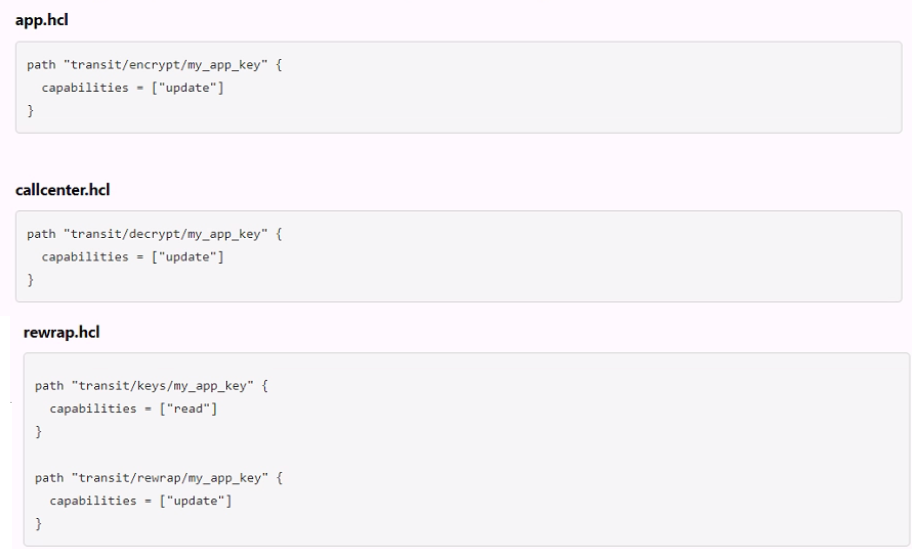
The following three policies exist in Vault. What do these policies allow an organization to do?
Answer : C
The three policies that exist in Vault are:
admins: This policy grants full access to all secrets and operations in Vault. It can be used by administrators or operators who need to manage all aspects of Vault.
default: This policy grants access to all secrets and operations in Vault except for those that require specific policies. It can be used as a fallback policy when no other policy matches.
transit: This policy grants access only to the transit secrets engine, which handles cryptographic functions on data in-transit. It can be used by applications or services that need to encrypt or decrypt data using Vault.
These policies allow an organization to perform useful tasks such as:
Encrypting, decrypting, and rewrapping data using the transit engine all in one policy: This policy grants access to both the transit secrets engine and the default policy, which allows performing any operation on any secret in Vault.
Creating a transit encryption key for encrypting, decrypting, and rewrapping encrypted data: This policy grants access only to the transit secrets engine and its associated keys, which are used for encrypting and decrypting data in transit using AES-GCM with a 256-bit AES key or other supported key types.
Separating permissions allowed on actions associated with the transit secret engine: This policy grants access only to specific actions related to the transit secrets engine, such as creating keys or wrapping requests. It does not grant access to other operations or secrets in Vault.
Which of the following describes usage of an identity group?
Answer : D
An identity group is a collection of entities that share some common attributes. An identity group can have one or more policies attached to it, which are inherited by all the members of the group. An identity group can also have subgroups, which can further refine the policies and attributes for a subset of entities.
One of the use cases of an identity group is to consistently apply the same set of policies to a collection of entities. For example, an organization may have different teams or departments, such as engineering, sales, or marketing. Each team may have its own identity group, with policies that grant access to the secrets and resources that are relevant to their work. By creating an identity group for each team, the organization can ensure that the entities belonging to each team have the same level of access and permissions, regardless of which authentication method they use to log in to Vault.Reference:Identity: entities and groups | Vault | HashiCorp Developer,vault_identity_group | Resources | hashicorp/vault | Terraform | Terraform Registry
An authentication method should be selected for a use case based on:
Answer : A
An authentication method should be selected for a use case based on the auth method that best establishes the identity of the client. The identity of the client is the basis for assigning a set of policies and permissions to the client in Vault. Different auth methods have different ways of verifying the identity of the client, such as using passwords, tokens, certificates, cloud credentials, etc. Depending on the use case, some auth methods may be more suitable or convenient than others. For example, for human users, the userpass or ldap auth methods may be easy to use, while for machines or applications, the approle or aws auth methods may be more secure and scalable. The choice of the auth method should also consider the trade-offs between security, performance, and usability.Reference:Auth Methods | Vault | HashiCorp Developer,Authentication - Concepts | Vault | HashiCorp Developer
Unlock All Features of HashiCorp Vault-Associate Dumps Software
Just have a look at the best and updated features of our Vault-Associate dumps which are described in detail in the following tabs. We are very confident that you will get the best deal on this platform.
Select Question Types you want
Set your desired pass percentage
Allocate Time (Hours: Minutes)
Create Multiple Practice test with limited questions
Customer Support
Latest Success Metrics For actual Vault-Associate Exam
This is the best time to verify your skills and accelerate your career. Check out last week's results, more than 90% of students passed their exam with good scores. You may be the Next successful Candidate.
95%
Average Passing Scores in final Exam
91%
Exactly Same Questions from these dumps
90%
Customers Passed HashiCorp Vault-Associate exam
OUR SATISFIED CUSTOMER REVIEWS
Mia Elizabeth
June 21, 2026
I passed the HashiCorp Vault-Associate exam with the help of Premiumdumps. I am glad to chose the right material to become successful in my career.
Lily Anne
June 19, 2026
My colleague suggested me to attempt HashiCorp Vault-Associate exam and prepare it with premiumdumps. I feel lucky, I attempted exam only with experts made practice questions
James Henry
June 17, 2026
Premiumdumps made me self-confident and assured with success. Its real exam simulation and self assessment tools helped me to pass Vault-Associate exam with good grades.
Marta Lopez
June 15, 2026
Premiumdumps has proven accommodating, which helped me to develop self confidence by offering self-evaluation tool. The self-assessment feature helped me to recognize my weak areas so I can overcome them. Thanks to Premiumdumps.
Kenji Sato
June 14, 2026
The HashiCorp Vault-Associate certification exam is very tough, and it was a challenging task to pass it. When I attempted it first time I couldn’t pass the exam, but then my colleague recommended me Premiumdumps exam material. The Premiumdumps offers best quality features, which enabled me to clear exam with exceptional grades.
David Smith
June 12, 2026
When I got registered for HashiCorp Vault-Associate exam, I was so afraid even to try. I gave-up initially, but then I found Premiumumps and today I am proud to make a right decision. I only spend 7 days in preparation, but the result was unanticipated. I got 100% marks and finally advanced my credentials.
Emily Johnson
June 9, 2026
I was so afraid even to attempt HashiCorp Vault-Associate exam, but then fortunately Premiumdumps happened to me like a blessing. I only prepared for the exam, for a week only and performed like an expert. Premiumdumps offered actual dumps to prepare for my certification exam in easy formats. I am really thankful to Premiumdumps for achieving success in my career.