Get Google Professional Security Operations Engineer Exam Practice Questions - Real and Updated
Google Professional Security Operations Engineer Exam Dumps
This Bundle Pack includes Following 3 Formats
Test software
Practice Test
Answers (PDF)
Professional Security Operations Engineer Desktop Practice
Test Software
Total Questions : 60
Professional Security Operations Engineer Questions & Answers
(PDF)
Total Questions : 60
Professional Security Operations Engineer Web Based Self Assessment Practice Test


Following are some Professional Security Operations Engineer Exam Questions for Review


You are implementing Google Security Operations (SecOps) with multiple log sources. You want to closely monitor the health of the ingestion pipeline's forwarders and collection agents, and detect silent sources within five minutes. What should you do?
You are an incident responder at your organization using Google Security Operations (SecOps) for monitoring and investigation. You discover that a critical production server, which handles financial transactions, shows signs of unauthorized file changes and network scanning from a suspicious IP address. You suspect that persistence mechanisms may have been installed. You need to use Google SecOps to immediately contain the threat while ensuring that forensic data remains available for investigation. What should you do first?
You need to augment your organization's existing Security Command Center (SCC) implementation with additional detectors. You have a list of known IoCs and would like to include external signals for this capability to ensure broad detection coverage. What should you do?
You received an IOC from your threat intelligence feed that is identified as a suspicious domain used for command and control (C2). You want to use Google Security Operations (SecOps) to investigate whether this domain appeared in your environment. You want to search for this IOC using the most efficient approach. What should you do?
You are implementing Google Security Operations (SecOps) for your organization. Your organization has their own threat intelligence feed that has been ingested to Google SecOps by using a native integration with a Malware Information Sharing Platform (MISP). You are working on the following detection rule to leverage the command and control (C2) indicators that were ingested into the entity graph.
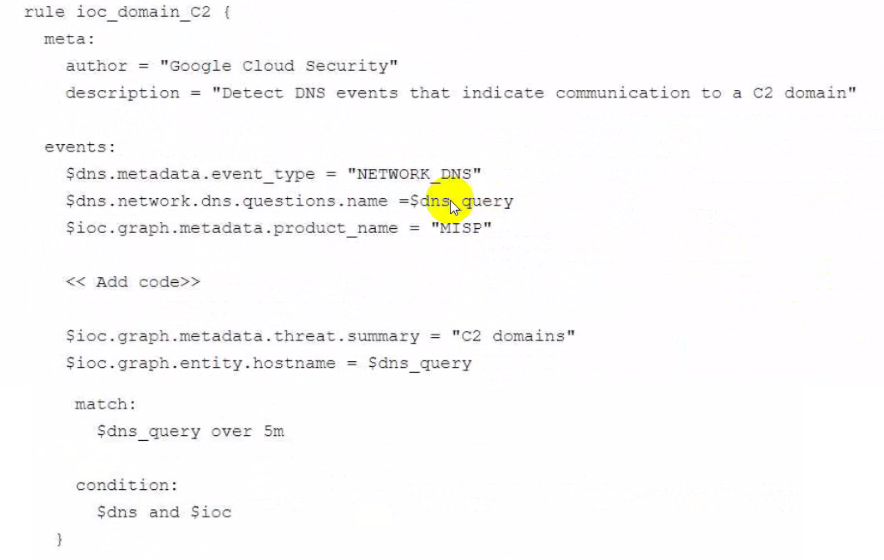
What code should you add in the detection rule to filter for the domain IOCS?
Unlock All Features of Google Professional Security Operations Engineer Dumps Software

Types you want

pass percentage

(Hours: Minutes)

Practice test with
limited questions

Support


