Which two statements about the FortiAnalyzer Fabric topology are true? (Choose two.)
Answer : B, D
Understanding FortiAnalyzer Fabric Topology:
The FortiAnalyzer Fabric topology is designed to centralize logging and analysis across multiple devices in a network.
It involves a hierarchy where the supervisor node manages and coordinates with other Fabric members.
Analyzing the Options:
Option A: Downstream collectors forwarding logs to Fabric members is not a typical configuration. Instead, logs are usually centralized to the supervisor.
Option B: For effective management and log centralization, logging devices must be registered to the supervisor. This ensures proper log collection and coordination.
Option C: The supervisor does not primarily use an API to store logs, incidents, and events locally. Logs are stored directly in the FortiAnalyzer database.
Option D: For the Fabric topology to function correctly, all Fabric members need to be in analyzer mode. This mode allows them to collect, analyze, and forward logs appropriately within the topology.
Conclusion:
The correct statements regarding the FortiAnalyzer Fabric topology are that logging devices must be registered to the supervisor and that Fabric members must be in analyzer mode.
Fortinet Documentation on FortiAnalyzer Fabric Topology.
Best Practices for Configuring FortiAnalyzer in a Fabric Environment.
A customer wants FortiAnalyzer to run an automation stitch that executes a CLI command on FortiGate to block a predefined list of URLs, if a botnet command-and-control (C&C) server IP is detected.
Which FortiAnalyzer feature must you use to start this automation process?
Answer : C
Understanding Automation Processes in FortiAnalyzer:
FortiAnalyzer can automate responses to detected security events, such as running commands on FortiGate devices.
Analyzing the Customer Requirement:
The customer wants to run a CLI command on FortiGate to block predefined URLs when a botnet C&C server IP is detected.
This requires an automated response triggered by a specific event.
Evaluating the Options:
Option A: Playbooks orchestrate complex workflows but are not typically used for direct event-triggered automation processes.
Option B: Data selectors filter logs based on criteria but do not initiate automation processes.
Option C: Event handlers can be configured to detect specific events (such as detecting a botnet C&C server IP) and trigger automation stitches to execute predefined actions.
Option D: Connectors facilitate communication between FortiAnalyzer and other systems but are not the primary mechanism for initiating automation based on log events.
Conclusion:
To start the automation process when a botnet C&C server IP is detected, you must use an Event handler in FortiAnalyzer.
Fortinet Documentation on Event Handlers and Automation Stitches in FortiAnalyzer.
Best Practices for Configuring Automated Responses in FortiAnalyzer.
Which statement describes automation stitch integration between FortiGate and FortiAnalyzer?
Answer : D
Overview of Automation Stitches: Automation stitches in Fortinet solutions enable automated responses to specific events detected within the network. This automation helps in swiftly mitigating threats without manual intervention.
FortiGate Security Profiles:
FortiGate uses security profiles to enforce policies on network traffic. These profiles can include antivirus, web filtering, intrusion prevention, and more.
When a security profile detects a violation or a specific event, it can trigger predefined actions.
Webhook Calls:
FortiGate can be configured to send webhook calls upon detecting specific security events.
A webhook is an HTTP callback triggered by an event, sending data to a specified URL. This allows FortiGate to communicate with other systems, such as FortiAnalyzer.
FortiAnalyzer Integration:
FortiAnalyzer collects logs and events from various Fortinet devices, providing centralized logging and analysis.
Upon receiving a webhook call from FortiGate, FortiAnalyzer can further analyze the event, generate reports, and take automated actions if configured to do so.
Detailed Process:
Step 1: A security profile on FortiGate triggers a violation based on the defined security policies.
Step 2: FortiGate sends a webhook call to FortiAnalyzer with details of the violation.
Step 3: FortiAnalyzer receives the webhook call and logs the event.
Step 4: Depending on the configuration, FortiAnalyzer can execute an automation stitch to respond to the event, such as sending alerts, generating reports, or triggering further actions.
FortiAnalyzer Administration Guide: Details on configuring event handlers and integrating with FortiGate.
FortiGate Administration Guide: Information on security profiles and webhook configurations.
By understanding the interaction between FortiGate and FortiAnalyzer through webhook calls and automation stitches, security operations can ensure a proactive and efficient response to security events.
Which observation about this FortiAnalyzer Fabric deployment architecture is true?
Answer : A
Understanding FortiAnalyzer Fabric Deployment:
FortiAnalyzer Fabric deployment involves a hierarchical structure where the Fabric root (supervisor) coordinates with multiple Fabric members (collectors and analyzers).
This setup ensures centralized log collection, analysis, and incident response across geographically distributed locations.
Analyzing the Exhibit:
FAZ1-Supervisor is located at AMER HQ and acts as the Fabric root.
FAZ2-Analyzer is a Fabric member located in EMEA.
FAZ3-Collector and FAZ4-Collector are Fabric members located in EMEA and APAC, respectively.
Evaluating the Options:
Option A: The statement indicates that the AMER HQ SOC team cannot run automation playbooks from the Fabric supervisor. This is true because automation playbooks and certain orchestration tasks typically require local execution capabilities which may not be fully supported on the supervisor node.
Option B: High availability (HA) configuration for the supervisor node is a best practice for redundancy but is not directly inferred from the given architecture.
Option C: The EMEA SOC team having access to historical logs only is not correct since FAZ2-Analyzer provides full analysis capabilities.
Option D: The APAC SOC team has access to FortiView and other reporting functions through FAZ4-Collector, but this is not explicitly detailed in the provided architecture.
Conclusion:
The most accurate observation about this FortiAnalyzer Fabric deployment architecture is that the AMER HQ SOC team cannot run automation playbooks from the Fabric supervisor.
Fortinet Documentation on FortiAnalyzer Fabric Deployment.
Best Practices for FortiAnalyzer and Automation Playbooks.
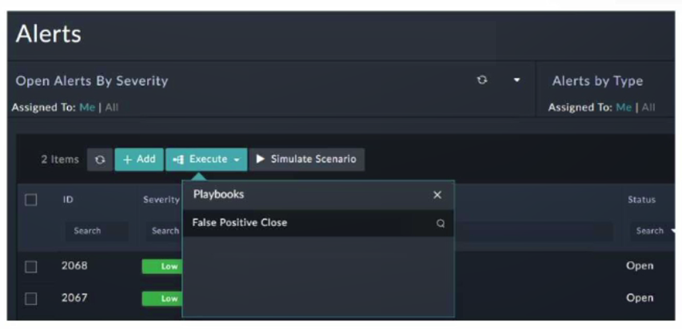
You configured a playbook named False Positive Close, and want to run it to verify if it works. However, when you click Execute and search for the playbook, you do not see it listed. Which two reasons could be the cause of the problem? (Choose two answers)
Answer : C, D
Comprehensive and Detailed Explanation From FortiSOAR 7.6., FortiSIEM 7.3 Exact Extract study guide:
In FortiSOAR 7.6, manual playbooks appear in the Execute menu of a record only if they meet specific configuration criteria defined in the Manual Trigger step:
Module Scope (C): When creating a playbook with a manual trigger, the administrator must explicitly select which modules (e.g., Alerts, Incidents, Indicators) can execute the playbook. If the Alerts module is not selected in the 'Applicable Modules' section of the trigger configuration, the playbook will remain hidden from the Execute menu when an analyst is viewing the Alerts module.
Trigger Execution Requirements (D): Manual triggers can be configured to execute on no records, a single record, or multiple records. If a playbook is configured with the 'Requires record input to run' setting but is specifically restricted to a different input type (or if there is a mismatch in the selection logic), it will not appear in the menu unless the correct number of records are selected. Furthermore, if a playbook is designed to run only when no record is selected (global utility), it will not show up in the context-sensitive menu of a specific record.
Why other options are incorrect:
Publishing (A): FortiSOAR playbooks do not require a separate 'publishing' step via an Application Editor to become visible. Once they are saved and active (toggled on), they are immediately available for use based on their trigger settings.
Concurrent Execution (B): FortiSOAR allows multiple instances of the same playbook to run simultaneously. An active execution of a playbook does not hide it from the menu for other analysts or subsequent runs.
Unlock All Features of Fortinet NSE7_SOC_AR-7.6 Dumps Software
Just have a look at the best and updated features of our NSE7_SOC_AR-7.6 dumps which are described in detail in the following tabs. We are very confident that you will get the best deal on this platform.
Select Question Types you want
Set your desired pass percentage
Allocate Time (Hours: Minutes)
Create Multiple Practice test with limited questions
Customer Support
Latest Success Metrics For actual NSE7_SOC_AR-7.6 Exam
This is the best time to verify your skills and accelerate your career. Check out last week's results, more than 90% of students passed their exam with good scores. You may be the Next successful Candidate.
95%
Average Passing Scores in final Exam
91%
Exactly Same Questions from these dumps
90%
Customers Passed Fortinet NSE7_SOC_AR-7.6 exam
OUR SATISFIED CUSTOMER REVIEWS
Devers
June 16, 2026
I was told that PremiumDumps is the solution to all of my worries regarding Fortinet NSE7_SOC_AR-7.6 test. I obtained 98% score and it justifies the reputation of PremiumDumps.
Charlie
June 15, 2026
I wish to express thank PremiumDumps very much for being here. I passed Fortinet NSE7_SOC_AR-7.6 test with a good score!
Jacinda Ardern
June 13, 2026
I have recently passed Fortinet NSE7_SOC_AR-7.6 exam with the excellent results, on the first attempt. I owe thanks to Premiumdumps, who helped to become certified Professional.
Noah James
June 11, 2026
I, being an average student, scored really well in NSE7_SOC_AR-7.6 Fortinet NSE 7 - Security Operations 7.6 Architect exam, only because of Premiumdumps practice questions. I highly recommend you to try actual exam dumps of Premiumdumps and pass the exam on the first try.
Lily Anne
June 9, 2026
My colleague suggested me to attempt Fortinet NSE7_SOC_AR-7.6 exam and prepare it with premiumdumps. I feel lucky, I attempted exam only with experts made practice questions
Jhonson
June 6, 2026
Premiumdumps is providing a very reliable support to all of the customers and so to me! I am very much obliged! I got 85% marks in my Certification test and this happened just because of Premiumdumps.
Leon Müller
June 5, 2026
I wish to share enthusiastically that I have finally advanced the credentials. And this has become possible just because of the Premiumdumps exam preparation material.