When configuring a FortiGate in a multi-WAN setup, why would an administrator enable session preservation on an interface? (Choose one answer)
Answer : D
A closely related routing principle from the guide is:
''For each session, FortiGate performs two route lookups... After completing these two lookups, FortiGate writes the routing information to its session table. Subsequent packets are routed according to the session table, not the routing table.''
Also, the guide notes an HA limitation that helps explain the same design principle for FortiGate-terminated sessions:
''Enabling session pickup allows active sessions to be seamlessly handed picked up by the new primary in the event of an HA failover... Note that there are some limitations to this -- for example, any sessions that terminate at the FortiGate itself (e.g. SSL VPN, proxy sessions) cannot be handed off to another FortiGate and must be restarted on the new primary.''
Technical Deep Dive:
The correct answer is D.
In multi-WAN environments, session preservation is used so that traffic for sessions that are tightly bound to the FortiGate interface they terminate on---most notably SSL VPN and other FortiGate-terminated flows---does not suddenly switch to another egress interface just because the routing table changes. Those sessions are sensitive to interface consistency. If replies start leaving through a different WAN after a route recalculation, the remote peer may see an address/interface mismatch and the session can break.
That means:
A is the opposite of session preservation. Preservation is meant to avoid moving active sessions around.
B is not the purpose of the feature.
C is unrelated.
D correctly describes why an administrator would enable it.
Operationally, this matters most for SSL VPN, management-plane flows, and other sessions that terminate on the FortiGate itself, not just ordinary transit traffic. Transit sessions are generally tracked in the session table and can often survive normal routing behavior more gracefully, but FortiGate-terminated sessions are much more sensitive to WAN/interface changes.
Which two conclusions can you make from the debug flow output? (Choose two answers)
Answer : A, D
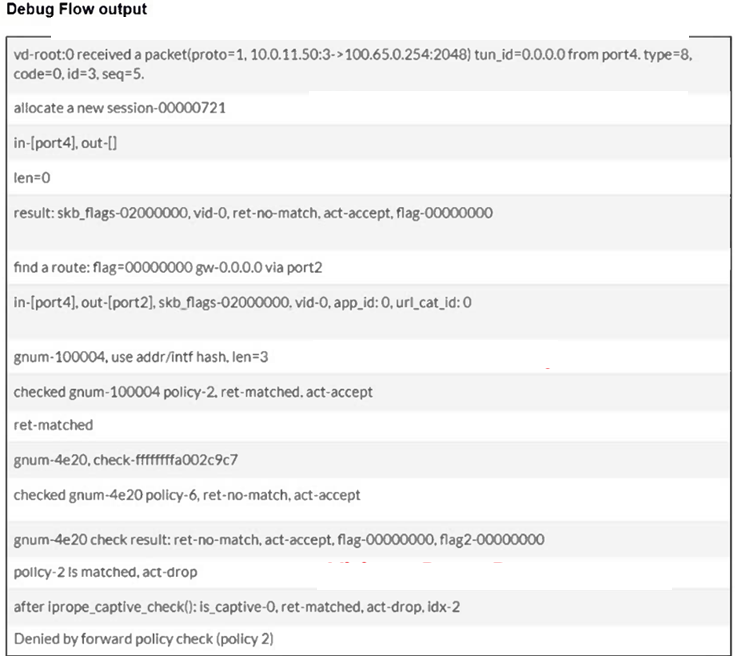
According to the FortiOS 7.6 Troubleshooting and Administration guides, the diagnose debug flow command provides a step-by-step trace of how the FortiGate unit processes a packet.
First, the line 'find a route: flag=00000000 gw-0.0.0.0 via port2' indicates that during the routing table lookup, the FortiGate matched the destination against its default route (represented by 0.0.0.0) and determined that the egress interface is port2. This confirms that the default gateway for this traffic is reachable via port2 (Statement A).
Second, the debug trace concludes with the messages 'policy-2 Is matched, act-drop' and 'Denied by forward policy check (policy 2)'. This explicitly indicates that the packet successfully matched the criteria for firewall policy ID 2, and the action configured for that policy is set to Deny (Statement D).
Statement B is incorrect because a Reverse Path Forwarding (RPF) failure would be indicated by a specific 'reverse path check fail, drop' message, which is absent here. Statement C is incorrect because the output shows 'proto=1', which corresponds to ICMP (Ping) traffic. UDP traffic would be identified as protocol 17.
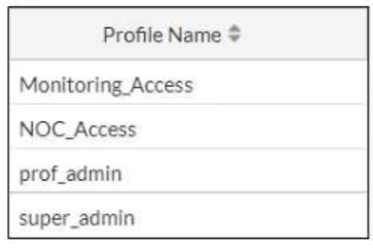
The NOC team connects to the FortiGate GUI with the NOC_Access admin profile. They request that their GUI sessions do not disconnect too early during inactivity. What must the administrator configure to answer this specific request from the NOC team? (Choose one answer)
Answer : D
According to the FortiOS 7.6 Administrator Study Guide, while there is a global administrative idle timeout setting that applies to all users by default (typically 5 minutes), FortiOS allows for granular control through Administrator Profiles. The Override Idle Timeout feature is specifically designed to allow different timeout values for different access profiles, which is ide1al for environments like a Network Operations Center (NOC) where persistent monitoring is required.23
To implement this, the administrator must modify the s4pecific access profile settings. By using the command config system accprofile 5and editing the NOC_Access profile, the administrator can enable the admintimeout-override and then increase the admintimeout value (Statement D). This configuration ensures that only the users assigned to that specific profile benefit from the extended session duration, maintaining a higher security posture for other administrative accounts that still follow the global timeout. Other options, such as changing the profile order (A) or assigning the super_admin role (C), do not address the specific requirement for inactivity timeout management. Option B is incorrect as 'offline value' is not a standard parameter for this feature.
An administrator wants to form an HA cluster using the FGCP protocol. Which two requirements must the administrator ensure both members fulfill? (Choose two answers)
Answer : A, D
''To successfully form an HA cluster, you must ensure that the members have the same:
* Model: hardware model or VM model
* Firmware version
* Licensing: includes the FortiGuard license, virtual domain (VDOM) license, FortiClient license, and so on
* Hard drive configuration: the same number and size of drives and partitions
* Operating mode: the operating mode---NAT mode or transparent mode---of the management VDOM.''
''From a configuration and setup point of view, you must ensure that the HA settings on each member have the same group ID, group name, password, and heartbeat interface settings. Try to place all heartbeat interfaces in the same broadcast domain, or for two-member clusters, connect them directly.''
Technical Deep Dive:
The correct answers are A and D.
A is correct because FGCP cluster formation requires matching HA parameters, and group ID is explicitly one of them. If the group ID differs, the units will not consider each other part of the same cluster during HA discovery and election.
D is correct because FortiGate HA expects hardware parity in critical platform characteristics, including hard drive configuration. If disk layout differs, the members do not satisfy the HA formation prerequisites.
B is incorrect because the study guide does not require heartbeat interfaces to be in the same IP subnet. The requirement is that heartbeat links be in the same broadcast domain, or directly connected in a two-node design. In practice, heartbeat links are Layer 2 adjacency links; IP subnet matching is not the stated requirement.
C is incorrect because the guide does not say both units must start with the same number of configured VDOMs. What must match is the licensing level and the operating mode of the management VDOM. After cluster formation, the primary synchronizes its configuration to the secondary.
A practical verification set before forming FGCP HA is:
get system status
show system ha
diagnose sys ha status
Operationally, FGCP then uses the heartbeat links for member discovery, health monitoring, election, and config/session synchronization. On supported hardware, session forwarding and HA processing can still benefit from FortiGate's ASIC-assisted architecture, but HA state, config sync, and election logic remain control-plane functions handled by FortiOS.
You have implemented the application sensor and the corresponding firewall policy as shown in the exhibits.
You cannot access any of the Google applications, but you are able to access www.fortinet.com.
Which two actions would you take to resolve the issue? (Choose two.)
Answer : B, E
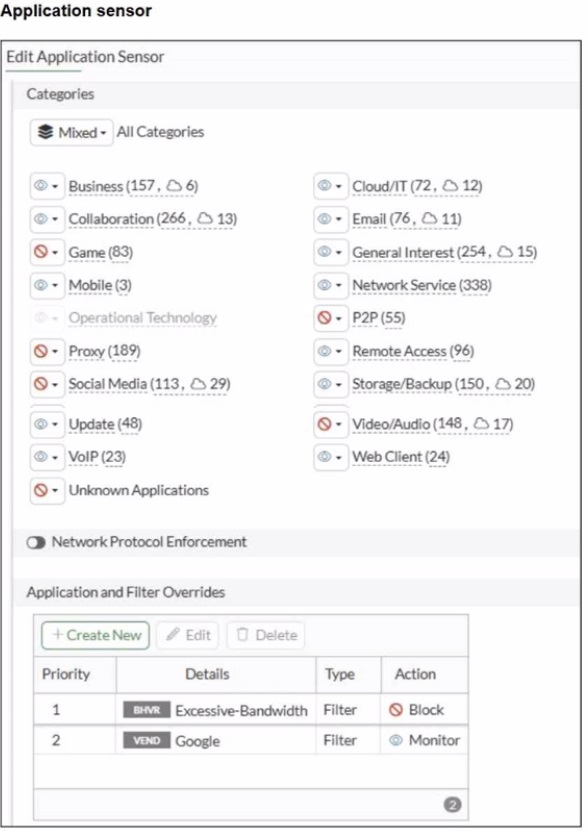
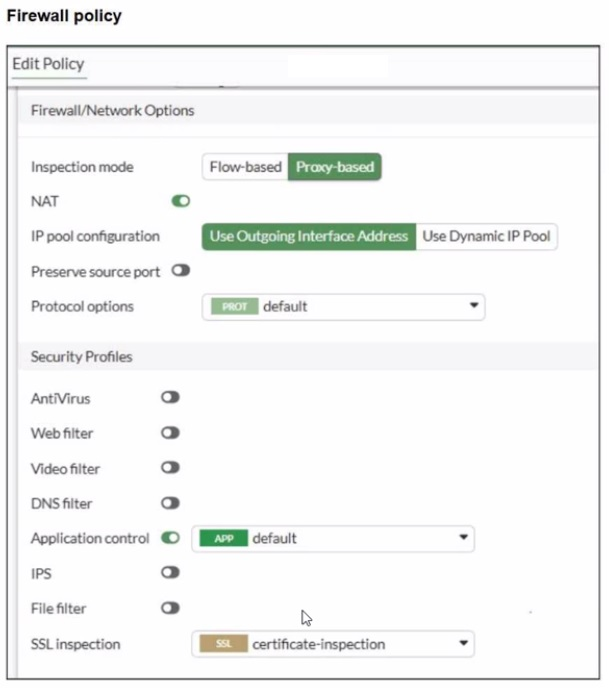
From the exhibits:
The firewall policy has Application Control enabled and uses certificate-inspection for SSL inspection.
The application sensor has Application and Filter Overrides with the following order (priority):
Excessive-Bandwidth with action Block
Google (vendor filter) with action Monitor
In FortiOS, Application and Filter Overrides are evaluated by priority (top-down). The first matching override is applied. If traffic matches an earlier override with Block, it will be blocked even if a later override would Monitor/Allow it.
Why Google apps fail while www.fortinet.com works:
Many Google applications can be detected as (or can trigger) the Excessive-Bandwidth behavior/signature depending on the specific service and traffic pattern.
Because Excessive-Bandwidth (Block) is above Google (Monitor), Google-related traffic may match the first rule and be blocked before the Google override is evaluated.
Access to www.fortinet.com works because that traffic is not matching the Excessive-Bandwidth override.
Therefore, to resolve:
B . Move up Google in the Application and Filter Overrides section to set its priority higher
This ensures Google matches the Google override before any broader blocking override is applied.
E . Set the action for Google in the Application and Filter Overrides section to Allow
This explicitly permits Google applications once the higher-priority match occurs (stronger than Monitor for troubleshooting and ensuring access).
Why the other options are not the best fit here:
A (deep-content inspection) can help identify more HTTPS applications, but the exhibit already shows a specific Google override configured; the immediate issue is the override evaluation order and action.
C relates to Web Filter URL categories, but the problem is occurring under Application Control behavior/vendor overrides.
D (flow-based) is not required to fix an override priority/action conflict.
Unlock All Features of Fortinet NSE4_FGT_AD-7.6 Dumps Software
Just have a look at the best and updated features of our NSE4_FGT_AD-7.6 dumps which are described in detail in the following tabs. We are very confident that you will get the best deal on this platform.
Select Question Types you want
Set your desired pass percentage
Allocate Time (Hours: Minutes)
Create Multiple Practice test with limited questions
Customer Support
Latest Success Metrics For actual NSE4_FGT_AD-7.6 Exam
This is the best time to verify your skills and accelerate your career. Check out last week's results, more than 90% of students passed their exam with good scores. You may be the Next successful Candidate.
95%
Average Passing Scores in final Exam
91%
Exactly Same Questions from these dumps
90%
Customers Passed Fortinet NSE4_FGT_AD-7.6 exam
OUR SATISFIED CUSTOMER REVIEWS
Jhonson
June 16, 2026
Premiumdumps is providing a very reliable support to all of the customers and so to me! I am very much obliged! I got 85% marks in my Certification test and this happened just because of Premiumdumps.
Grim
June 15, 2026
Premiumdumps Practice Questions have been a help for me whilst preparing for my Fortinet NSE4_FGT_AD-7.6 test. I wanted to have 99% marks in the test and I did! Thanks to Premiumdumps!
Ava Grace
June 12, 2026
When I got enrolled in Fortinet NSE4_FGT_AD-7.6, I was told that Premiumdumps is the only key to all of my worries regarding my Exam. I scored well and it justifies the standard of Premiumdumps
Noah James
June 10, 2026
I, being an average student, scored really well in NSE4_FGT_AD-7.6 Fortinet NSE 4 - FortiOS 7.6 Administrator exam, only because of Premiumdumps practice questions. I highly recommend you to try actual exam dumps of Premiumdumps and pass the exam on the first try.
Leon Müller
June 9, 2026
I wish to share enthusiastically that I have finally advanced the credentials. And this has become possible just because of the Premiumdumps exam preparation material.
Jacinda Ardern
June 6, 2026
I have recently passed Fortinet NSE4_FGT_AD-7.6 exam with the excellent results, on the first attempt. I owe thanks to Premiumdumps, who helped to become certified Professional.
James Henry
June 4, 2026
With the help of Premiumdumps exam questions, I scored well in the Fortinet NSE4_FGT_AD-7.6 certification exam. I am grateful to Premiumdumps who made me pass the exam.