An analyst investigated a website and produced the following:
Starting Nmap 7.92 ( https://nmap.org ) at 2022-07-21 10:21 CDT
Nmap scan report for insecure.org (45.33.49.119)
Host is up (0.054s latency).
rDNS record for 45.33.49.119: ack.nmap.org
Not shown: 95 filtered tcp ports (no-response)
PORT STATE SERVICE VERSION
22/tcp open ssh OpenSSH 7.4 (protocol 2.0)
25/tcp closed smtp
80/tcp open http Apache httpd 2.4.6
113/tcp closed ident
443/tcp open ssl/http Apache httpd 2.4.6
Service Info: Host: issues.nmap.org
Service detection performed. Please report any incorrect results at https://nmap .org/submit/ .
Nmap done: 1 IP address (1 host up) scanned in 20.52 seconds
Which of the following syntaxes did the analyst use to discover the application versions on this vulnerable website?
Answer : C
The analyst used the command nmap -sV -T4 -F insecure.org to discover the application versions on the vulnerable website. The -sV option in Nmap is used to perform version detection, which identifies the versions of the services running on open ports. The -T4 option sets the timing template for faster execution, and -F scans only the most common ports.
A security operations center receives the following alerts related to an organization's cloud tenant:
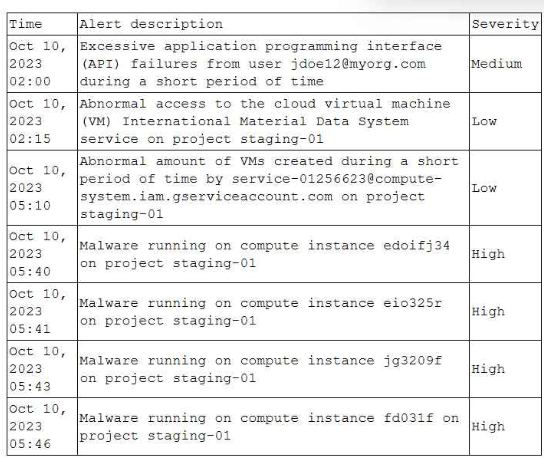
Which of the following should an analyst do first to identify the initial compromise?
Answer : B
To identify the initial compromise, the analyst should start with the earliest suspicious activity in the timeline and pivot into the audit logs for the principal (identity) associated with that first alert.
Here, the first notable event is 02:00 excessive API failures tied to jdoe12@myorg.com. That commonly indicates password guessing, token misuse, or other authentication abuse attempts. The next events (02:15 metadata service access, 05:10 mass VM creation by a service account, 05:40 malware) look like follow-on activity after an initial foothold. Therefore, the best first step is to check whether those API failures were followed by any successful API calls by that user and then correlate those successful actions to the later stages in project staging-01.
This approach aligns with CySA+ guidance that analysts should use logs + timestamps to build a timeline and correlate events across identities/systems to understand scope and progression:
Sybex emphasizes correlating events from multiple sources and using that correlation to determine scope and impact:
Exact extract (Sybex Study Guide): ''Security analysts are often asked to help analyze that data... Knowing if other events are correlated with the initial event... [and] understanding what systems, users, services, or other assets were involved...''
Secbay underscores that logs and timestamps are key to forming an accurate incident timeline (which is exactly what we're doing by starting from the earliest alert):
Exact extract (Secbay Press): ''System and application logs with timestamps help create a timeline of events, aiding in understanding when specific actions occurred during the incident.''
Why Option B is best vs. the others
B starts with the earliest suspicious identity and seeks successful API activity that would confirm compromise and explain subsequent actions (metadata access service account actions malware).
A is too broad initially (''all activity under project staging-01'') and anchors on a VM that only appears later; it's not the best first pivot when you already have an earlier suspect identity.
C starts at the compute-instance phase (05:10) rather than the earliest authentication/API anomaly (02:00), so it's more likely to find post-compromise actions rather than the initial entry.
D anchors on a specific later VM (fd031f) and compute APIs, again likely after the initial compromise.
Reference (CompTIA CySA+ CS0-003 documents / study guides used):
Mike Chapple & David Seidl, CompTIA CySA+ Study Guide (CS0-003): correlate other events with the initial event; identify involved users/systems/services
Secbay Press, CompTIA CySA+ Exam Prep Guide (CS0-003): logs + timestamps build a timeline of events and support analysis of incident progression
A security analyst detects an email server that had been compromised in the internal network. Users have been reporting strange messages in their email inboxes and unusual network traffic. Which of the following incident response steps should be performed next?
Answer : C
After detecting a compromised email server and unusual network traffic, the next step in incident response is containment, to prevent further damage or spread of the compromise.Reference:CompTIA CySA+ Study Guide: Exam CS0-003, 3rd Edition, Chapter 5: Incident Response, page 197.
Which of the following is the appropriate phase in the incident response process to perform a vulnerability scan to determine the effectiveness of corrective actions?
Answer : C
Comprehensive and Detailed Step-by-Step Performing a vulnerability scan during the recovery phase ensures that corrective actions, such as patches or configuration changes, have effectively addressed the vulnerabilities exploited during the incident. This step validates the system's security before fully restoring operations.
A security analyst receives an alert for suspicious activity on a company laptop An excerpt of the log is shown below:
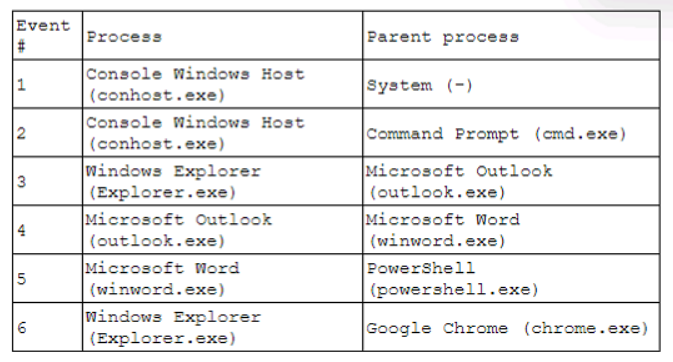
Which of the following has most likely occurred?
Answer : A
An Office document with a malicious macro was opened is the most likely explanation for the suspicious activity on the company laptop, as it reflects the common technique of using macros to execute PowerShell commands that download and run malware. A macro is a piece of code that can automate tasks or perform actions in an Office document, such as a Word file or an Excel spreadsheet. Macros can be useful and legitimate, but they can also be abused by threat actors to deliver malware or perform malicious actions on the system. A malicious macro can be embedded in an Office document that is sent as an attachment in a phishing email or hosted on a compromised website. When the user opens the document, they may be prompted to enable macros or content, which will trigger the execution of the malicious code. The malicious macro can then use PowerShell, which is a scripting language and command-line shell that is built into Windows, to perform various tasks, such as downloading and running malware from a remote URL, bypassing security controls, or establishing persistence on the system. The log excerpt shows that PowerShell was used to download a string from a URL using the WebClient.DownloadString method, which is a common way to fetch and execute malicious code from the internet. The log also shows that PowerShell was used to invoke an expression (iex) that contains obfuscated code, which is another common way to evade detection and analysis. The other options are not as likely as an Office document with a malicious macro was opened, as they do not match the evidence in the log excerpt. A credential-stealing website was visited is possible, but it does not explain why PowerShell was used to download and execute code from a URL. A phishing link in an email was clicked is also possible, but it does not explain what happened after the link was clicked or how PowerShell was involved. A web browser vulnerability was exploited is unlikely, as it does not explain why PowerShell was used to download and execute code from a URL.
Unlock All Features of CompTIA CS0-003 Dumps Software
Just have a look at the best and updated features of our CS0-003 dumps which are described in detail in the following tabs. We are very confident that you will get the best deal on this platform.
Select Question Types you want
Set your desired pass percentage
Allocate Time (Hours: Minutes)
Create Multiple Practice test with limited questions
Customer Support
Latest Success Metrics For actual CS0-003 Exam
This is the best time to verify your skills and accelerate your career. Check out last week's results, more than 90% of students passed their exam with good scores. You may be the Next successful Candidate.
95%
Average Passing Scores in final Exam
91%
Exactly Same Questions from these dumps
90%
Customers Passed CompTIA CS0-003 exam
OUR SATISFIED CUSTOMER REVIEWS
Anya Claire
June 19, 2026
I was losing confidence fast. No matter how much I studied, I just couldn’t get a handle on the syllabus, and the exam date was looming. Then I found these CS0-003 dumps. They really focused on the areas such as indicators of malicious activity where I struggled and helped me improve quickly. I ended up passing the exam without any problems!