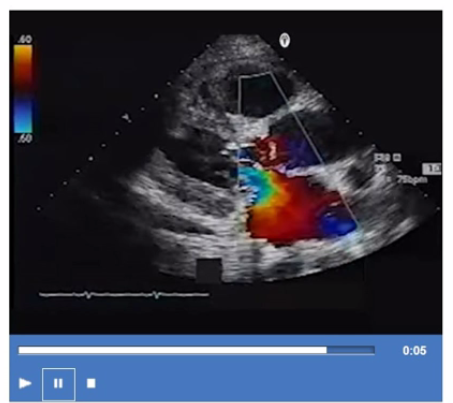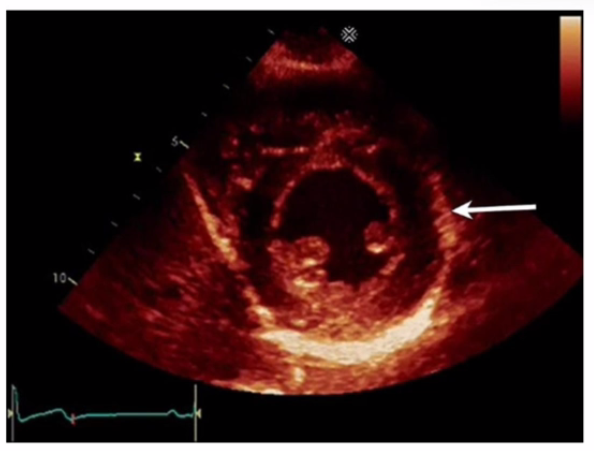
Which condition is commonly associated with cardiac tamponade?
Answer : D
Comprehensive and Detailed Explanation From Exact Extract:
Cardiac tamponade occurs when fluid accumulation in the pericardial space increases intrapericardial pressure, restricting ventricular filling and reducing cardiac output. A hallmark clinical feature is hypotension due to decreased stroke volume and cardiac output.
Jugular venous pressure is typically elevated (not decreased) because of impaired right heart filling. Tachycardia, not bradycardia, is usually present as a compensatory response. Blood pressure tends to be low or normal, not hypertensive.
This pathophysiology and clinical presentation are well documented in adult echocardiography literature and clinical cardiology textbooks, where tamponade is diagnosed with signs such as right atrial and ventricular diastolic collapse and associated clinical hypotension and elevated venous pressures16:Textbook of Clinical Echocardiography, 6ep.280-28512:ASE Pericardial Disease Guidelinesp.300-305.
Which valvular pathology is illustrated in this left heart pressure tracing?
Answer : A
Comprehensive and Detailed Explanation From Exact Extract:
The pressure tracing shows left atrial (LA), left ventricular (LV), and aortic (AO) pressures over time. The key feature is the large pressure gradient between the LA and LV during diastole (arrow pointing at early diastolic phase), where the LA pressure is elevated and there is a delayed, gradual rise in LV pressure during diastolic filling. This finding is typical of mitral stenosis, where obstruction at the mitral valve causes increased LA pressure and a pressure gradient between LA and LV during diastole.
In aortic stenosis, the pressure gradient is primarily between LV and AO during systole. Mitral regurgitation shows elevated LA pressure but not a diastolic gradient. Aortic regurgitation shows elevated LV diastolic pressure with aortic diastolic pressure falling.
These characteristic hemodynamic patterns are described in clinical cardiology and echocardiography literature and hemodynamic references such as the 'Textbook of Clinical Echocardiography' and cardiac catheterization textbooks16:Textbook of Clinical Echocardiography, 6ep.360-36512:Hemodynamic Textsp.50-60.
Which structure is the arrow pointing to in this video?
Answer : C
The arrow points to the coronary sinus, which is a venous structure located posteriorly in the atrioventricular groove, emptying into the right atrium. It appears as a circular anechoic structure near the left atrium in echocardiographic images.
Left lower pulmonary vein enters the left atrium more superiorly. Descending aorta is posterior to the heart but not in this location. Left atrial appendage is an anterior finger-like projection of the left atrium, separate from the coronary sinus.
This anatomy is described in the 'Textbook of Clinical Echocardiography, 6e', Chapter on Cardiac Venous Anatomy20:140-145Textbook of Clinical Echocardiography.
What is the significance of a mitral B-bump seen on M-mode?
Answer : A
The mitral B-bump on M-mode echocardiography represents a distinct anterior motion or thickening of the anterior mitral leaflet during atrial systole. It is associated with elevated left atrial systolic pressure.
The B-bump is a marker of increased left atrial pressure transmitted to the mitral valve, often seen in diastolic dysfunction and conditions causing elevated left atrial pressure.
It is not a direct indicator of left ventricular end-diastolic pressure, hypertrophic obstructive cardiomyopathy, or mitral stenosis.
This phenomenon is described in the 'Textbook of Clinical Echocardiography, 6e', Chapter on Diastolic Function and Mitral Valve Motion20:215-220Textbook of Clinical Echocardiography.
Which of the following is a feature of constrictive pericarditis?
Answer : D
Comprehensive and Detailed Explanation From Exact Extract:
Constrictive pericarditis is characterized by thickening and fibrosis of the pericardium which restricts diastolic filling of the ventricles. Key echocardiographic features include a characteristic interventricular septal 'bounce' or shift during early diastole due to the abrupt cessation of ventricular filling imposed by the rigid pericardium. This septal bounce reflects rapid early diastolic filling followed by a sudden halt as filling pressures equalize, a hallmark of constriction physiology.
Additionally, Doppler studies show marked respiratory variation in mitral and tricuspid inflow velocities (>25%), with an inspiratory increase in tricuspid inflow and a decrease in mitral inflow velocity, reflecting ventricular interdependence caused by the noncompliant pericardium. The mitral inflow typically shows a large E-wave with a small or absent A-wave and a steep deceleration slope, but importantly these velocities vary significantly with respiration, which is not the case in restrictive cardiomyopathy.
Hepatic vein Doppler often reveals a prominent a-wave and a deep y-descent with increased diastolic flow reversal during expiration, indicating elevated right atrial pressures and constrictive physiology.
The inferior vena cava (IVC) is usually dilated and shows no inspiratory collapse (i.e., no normal collapse with sniff test) because of elevated right atrial pressure and impaired venous return.
Therefore:
Option A is incorrect because mitral inflow in constrictive pericarditis shows significant respiratory variation, not absence of it.
Option B is incorrect because the hepatic vein is typically dilated with abnormal flow patterns, not normal size.
Option C is incorrect because the IVC is dilated and does NOT collapse normally with inspiration/sniff in constrictive pericarditis.
Option D is correct because the interventricular septal bounce is a classic feature reflecting ventricular interdependence and constrictive physiology.
These findings are summarized in the 'Textbook of Clinical Echocardiography, 6e' (Catherine M. Otto, MD), Chapter 10 (Pericardial Disease), pages 280--285, with key illustrations showing septal bounce, Doppler inflow variations, hepatic vein flow patterns, and IVC findings in constrictive pericarditis. The 'Mayo Clinic criteria' for echocardiographic diagnosis also emphasize ventricular septal shift as a critical feature, often combined with tissue Doppler annular velocity patterns and hepatic vein diastolic flow reversal for high diagnostic accuracy.
Unlock All Features of ARDMS AE-Adult-Echocardiography Dumps Software
Just have a look at the best and updated features of our AE-Adult-Echocardiography dumps which are described in detail in the following tabs. We are very confident that you will get the best deal on this platform.
Select Question Types you want
Set your desired pass percentage
Allocate Time (Hours: Minutes)
Create Multiple Practice test with limited questions
Customer Support
Latest Success Metrics For actual AE-Adult-Echocardiography Exam
This is the best time to verify your skills and accelerate your career. Check out last week's results, more than 90% of students passed their exam with good scores. You may be the Next successful Candidate.
I wish to share enthusiastically that I have finally advanced the credentials. And this has become possible just because of the Premiumdumps exam preparation material.
Charlie
June 1, 2026
I wish to express thank PremiumDumps very much for being here. I passed ARDMS AE-Adult-Echocardiography test with a good score!
David Smith
May 30, 2026
When I got registered for ARDMS AE-Adult-Echocardiography exam, I was so afraid even to try. I gave-up initially, but then I found Premiumumps and today I am proud to make a right decision. I only spend 7 days in preparation, but the result was unanticipated. I got 100% marks and finally advanced my credentials.
João Silva
May 29, 2026
I would like to share, initially I was not sure if I could pass the AE Adult Echocardiography Examination exam, because I didn’t get time to prepare for it. But Premiumdumps Practice exam helped me to fulfill my dream. The user friendly interface made be acquainted with the actual exam by offering the real exam simulation. I give all credits to Premiumdumps.
Kenji Sato
May 27, 2026
The ARDMS AE-Adult-Echocardiography certification exam is very tough, and it was a challenging task to pass it. When I attempted it first time I couldn’t pass the exam, but then my colleague recommended me Premiumdumps exam material. The Premiumdumps offers best quality features, which enabled me to clear exam with exceptional grades.
Mia Elizabeth
May 25, 2026
I passed the ARDMS AE-Adult-Echocardiography exam with the help of Premiumdumps. I am glad to chose the right material to become successful in my career.
Yuko Tanaka
May 22, 2026
Premiumsdumps practice questions prepared me well for my ARDMS AE-Adult-Echocardiography exams. And helped me to eliminate the exam anxiety. I didn’t feel any pressure while in the exam, because the practice exam of Premiumdumps was quite similar and helped me to pass exam on the first try.