
Get Arcitura Education S90.20 Exam Practice Questions - Real and Updated
Arcitura Education SOA Security Lab Exam Dumps
This Bundle Pack includes Following 3 Formats
Test software
Practice Test
Answers (PDF)

S90.20 Desktop Practice
Test Software
Total Questions : 30

S90.20 Questions & Answers
(PDF)
Total Questions : 30

S90.20 Web Based Self Assessment Practice Test


Following are some S90.20 Exam Questions for Review


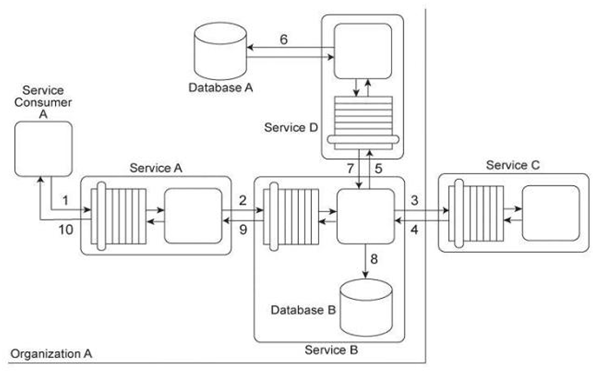
Service Consumer A sends a request message to Service A (1), after which Service A sends a request message to Service B (2). Service B forwards the message to have its contents calculated by Service C (3). After receiving the results of the calculations via a response message from Service C (4), Service B then requests additional data by sending a request message to Service D (5). Service D retrieves the necessary data from Database A (6), formats it into an XML document, and sends the response message containing the XML-formatted data to Service B (7). Service B appends this XML document with the calculation results received from Service C, and then records the entire contents of the XML document into Database B (8). Finally, Service B sends a response message to Service A (9) and Service A sends a response message to Service Consumer A (10). Services A, B and D are agnostic services that belong to Organization A and are also being reused in other service compositions. Service C is a publicly accessible calculation service that resides outside of the organizational boundary. Database A is a shared database used by other systems within Organization A and Database B is dedicated to exclusive access by Service B .Recently, Service D received request messages containing improperly formatted database retrieval requests. All of these request messages contained data that originated from Service C .There is a strong suspicion that an attacker from outside of the organization has been attempting to carry out SOL injection attacks. Furthermore, it has been decided that each service that writes data to a database must keep a separate log file that records a timestamp of each database record change. Because of a data privacy disclosure requirement used by Organization A, the service contracts of these services need to indicate that this logging activity may occur. How can the service composition architecture be improved to avoid SQL injection attacks originating from Service C - and - how can the data privacy disclosure requirement be fulfilled?
Service A provides a data access capability that can be used by a variety of service consumers. The database records accessed by Service A are classified as either private or public. There are two types of service consumers that use Service A:
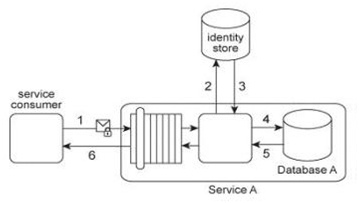
Service consumers with public access permissions (allowed to access only public data records) and service consumers with private access permissions (allowed to access all data records). For performance reasons the Service A architecture uses a single database, named Database A .Each record in Database A is classified as either private or public. After Service A is invoked by a service consumer (1), it authenticates the request message using an identity store and retrieves the corresponding authorization (2, 3). Once authorized, the service consumer's request is submitted to Database A (4), which then returns the requested data (5) If the service consumer has private access permissions, all of the returned data is included in Service A's response message (6). If the service consumer has public access permissions, then Service A first filters the data in order to remove all unauthorized private data records, before sending to the response message to the service consumer (6). An investigation recently detected that private data has been leaked to unauthorized service consumers. An audit of the Service A architecture revealed that Service A's filtering logic is flawed, resulting in situations where private data was accidentally shared with service consumers that only have public access permissions. Further, it was discovered that attackers have been monitoring response messages sent by Service A in order to capture private data. It is subsequently decided to split Database A into two databases:
one containing only private data (the Private Database) and the other containing only public data (the Public Database). What additional changes are necessary to address these security problems?
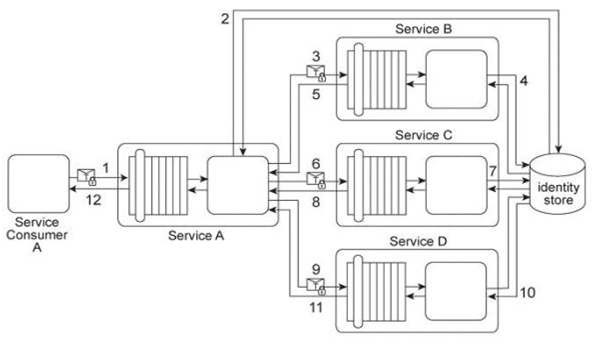
Service Consumer A sends a request message with a Username token to Service A (1). Service B authenticates the request by verifying the security credentials from the Username token with a shared identity store (2), To process Service Consumer A's request message. Service A must use Services B, C, and D .Each of these three services also requires the Username token (3. 6, 9) in order to authenticate Service Consumer A by using the same shared identity store (4, 7, 10). Upon each successful authentication, each of the three services (B, C, and D) issues a response message back to Service A (5, 8, 11). Upon receiving and processing the data in all three response messages, Service A sends its own response message to Service Consumer A (12). There are plans implement a single sign-on security mechanism in this service composition architecture. The service contracts for Services A, C, and D can be modified with minimal impact in order to provide support for the additional messaging requirements of the single sign-on mechanism. However, Service B's service contract is tightly coupled to its implementation and, as a result, this type of change to its service contract is not possible as it would require too many modifications to the underlying service implementation. Given the fact that Service B's service contract cannot be changed to support single sign-on, how can a single sign-on mechanism still be implemented across all services?
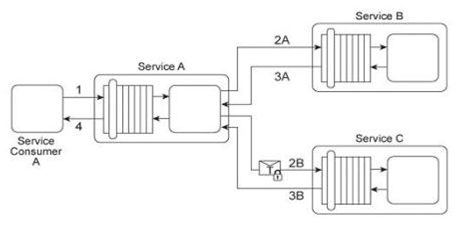
Service A is a publically accessible service that provides free multimedia retrieval capabilities to a range of service consumers. To carry out this functionality, Service A is first invoked by Service Consumer A (1). Based on the nature of the request message received from Service Consumer A, Service A either invokes Service B or Service C .When Service B is invoked by Service A (2A) it retrieves data from publicly available sources (not shown) and responds with the requested data (3A). When Service C is invoked by Service A (2B) it retrieves data from proprietary sources within the IT enterprise (not shown) and responds with the requested data (3B). After receiving a response from Service B or Service C, Service A sends the retrieved data to Service Consumer A (4). Service B does not require service consumers to be authenticated, but Service C does require authentication of service consumers. The service contract for Service A therefore uses WS-Policy alternative policies in order to express the two different authentication requirements to Service Consumer A .When Service Consumer A sends a request message (1), Service A determines whether the request requires the involvement of Service C and then checks to ensure that the necessary security credentials were received as part of the message. If the credentials provided by Service Consumer A are verified. Service A creates a signed SAML assertion and sends it with the request message to Service C (2B) This authentication information is protected by public key encryption However, responses to Service Consumer A's request message (3B, 4) are not encrypted for performance reasons. The owner of Service C is planning two changes to the service architecture:
1. A fee will be charged to Service Consumer A (or any service consumer) using Service C .2. The response messages issued by Service C need to be secured in order to prevent unauthorized access. An analysis of Service C's usage statistics reveals that a group of service consumers specifically request the retrieval of multimedia data on a frequent basis. To promote the usage of Service C to these types of service consumers, the owner of Service C plans to offer a special discount by allowing unlimited multimedia retrievals for a fixed monthly price. Service consumers that do not subscribe to this promotion will need to pay for each request individually. It is anticipated that the new promotion will significantly increase the usage of Service C .The owner of Service C therefore wants to ensure that the security added to the response messages has a minimal impact on Service C's runtime performance. What steps can be taken to fulfill these requirements?
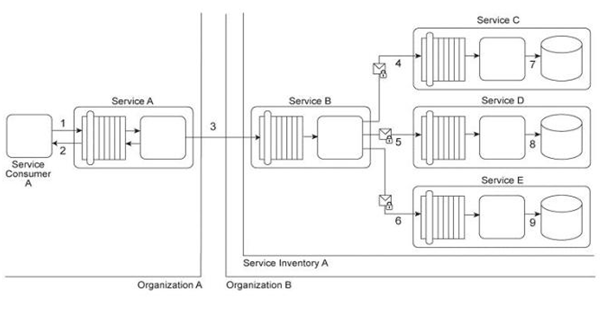
Service Consumer A sends a request to Service A (1). Service A replies with an acknowledgement message (2) and then processes the request and sends a request message to Service B (3). This message contains confidential financial data. Service B sends three different request messages together with its security credentials to Services C .D .and E (4, 5, 6). Upon successful authentication, Services C .D .and E store the data from the message in separate databases (7.8, 9). Services B .C .D, and E belong to Service Inventory A, which further belongs to Organization B .Service Consumer A and Service A belong to Organization A .Organization B decides to create a new service inventory (Service Inventory B) for services that handle confidential data. Access to these services is restricted by allocating Service Inventory B its own private network. Access to this private network is further restricted by a dedicated firewall. Services C, D and E are moved into Service Inventory B, and as a result. Service B can no longer directly access these services. How can this architecture be changed to allow Service B to access Services C, D and E in a manner that does not jeopardize the security of Service Inventory B while also having a minimal impact on the service composition's performance?
Unlock All Features of Arcitura Education S90.20 Dumps Software

Types you want

pass percentage

(Hours: Minutes)

Practice test with
limited questions

Support


